
SUV Rental in Punta Cana: Which One You Actually Need
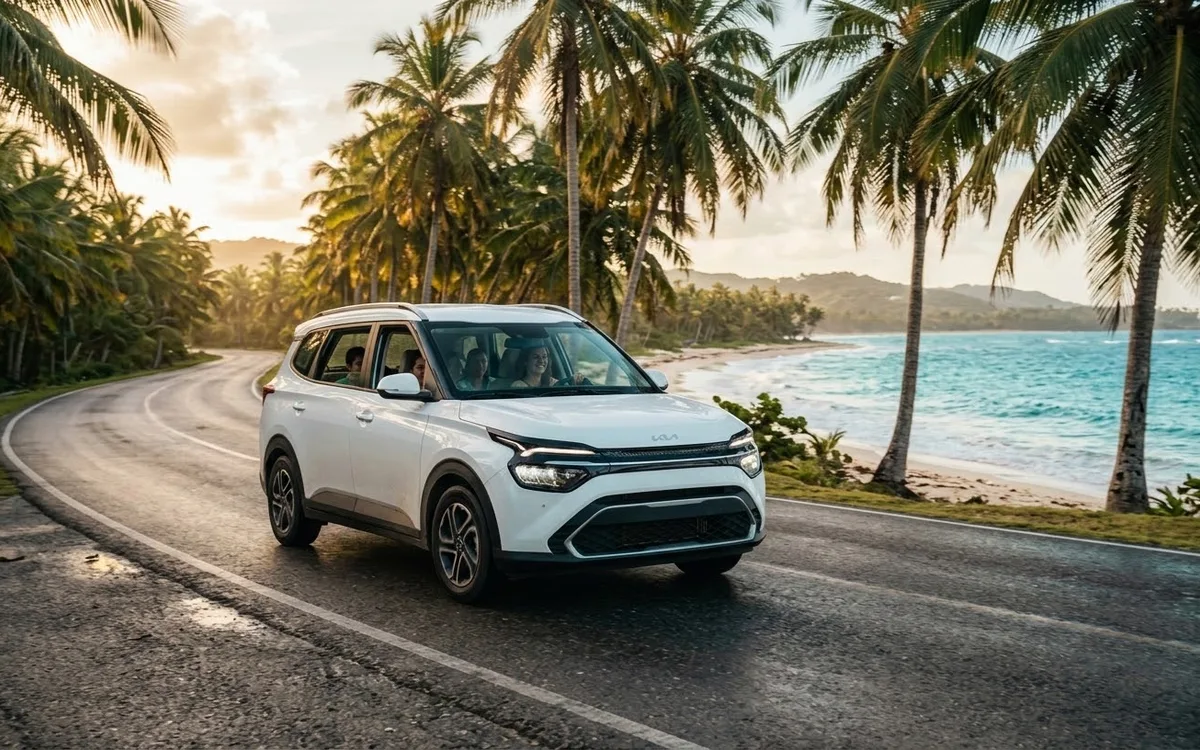
Most people renting an SUV in Punta Cana are solving a luggage problem, not a terrain problem. Worth knowing before you pay for one, because the marketing in this market is all about rugged Dominican roads and the actual reason to size up is that five suitcases don’t fit in a Kia Rio.
I run a rental company here. Below is which of our cars suits which trip, what an SUV genuinely buys you, and when a small car is the better call. If you already know you need one, here’s SUV rental in Punta Cana with all-in prices.
Service area: Punta Cana, PUJ airport, Bávaro, Cap Cana, Uvero Alto, and the resorts and villas in between.
What ground clearance is actually for here
Not mud. There’s very little mud on any route a tourist drives.
It’s for the speed bumps. Called policías acostados locally, they’re tall, frequently unpainted, and often sit just past a bend or at the entrance to a village where nothing warns you. Alongside them: the drainage channels cut straight across village roads, and the kerbs at beach access points that were never built with a low front bumper in mind.
That’s the whole case for clearance, and it’s a real one. It’s just smaller and more specific than “you need a 4x4 for Dominican roads”, which you don’t, for anywhere in this article.
The damage I actually see, in rough order of frequency: a cracked front bumper lip from a bump taken at speed, kerbed alloys from parking on a verge, and an exhaust heat shield knocked loose by a drainage channel. All three are low-car problems and none of them involve anything you’d call off-roading. None of them happen on the motorway either, which is the part people worry about in advance. They happen four hundred metres from a beach, on a road that looked completely ordinary, at about 40 km/h, in daylight, with everybody relaxed. That is the moment a bit of ride height pays for itself, and it’s also why I’d rather sell somebody a $75 Sonet than a $45 Picanto they’ll be nervous in.
The paved network, meanwhile, is genuinely good. The Autovía del Coral to La Romana and Santo Domingo is a proper motorway, and Macao, Bayahíbe, Higüey and the whole resort corridor are fine in a Picanto.
So the SUV is a comfort decision, not a safety one. Worth being clear about.
Which of ours fits which trip
| Car | Seats | From | Suits |
|---|---|---|---|
| Kia Sonet | 5 | $75/day | Two or three people who want height and easy parking |
| Nissan Kicks | 5 | $75 | Same brief, slightly larger boot |
| Kia Carens | 7 | $85 | Families. Folding third row, still parkable |
| Suzuki XL-7 | 7 | $85 | Groups with a lot of luggage |
| Toyota Rush | 7 | $85 | Higher clearance, rougher village roads |
| Dodge Grand Caravan | 7 | $85 | Maximum boot volume; a minivan, not an SUV |
| Honda BR-V | 7 | $89 | Seven seats plus comfort on long drives |
| Toyota Highlander | 7 | $199 | Six adults and a real distance to cover |
| Mercedes GLC | 5 | $149 | Couples who’d rather arrive in one |
| Mercedes GLE | 7 | $299 | The top of the range |
Those rates fall on longer bookings. The Kia Sonet and the Nissan Kicks run $67 over a week, $61 over a fortnight and $56 over a month; the Kia Carens holds nearer its daily rate and lands at $70 over a month, and the Suzuki XL-7 runs $79, $75 and $70 on the same steps. Insurance, taxes and unlimited mileage are inside all of them. If it’s down to the two family cars, you can compare both 7-seaters and check availability.
Seven seats for five people
This is the recommendation I make most often and it has almost nothing to do with passengers.
Five travellers do not arrive with five small bags. They arrive with five large cases, five carry-ons, two beach bags and a pushchair, and by day four there’s a supermarket run and a box of rum in there too. Fold the third row of a seven-seater and the boot stops being the constraint on the holiday. That is the whole case for 7-seater and minivan rental in Punta Cana over a five-seat crossover.
The seven-seaters here cost $85 to $89 a day. A five-seat crossover costs $75.
Ten dollars a day is the whole premium for that flexibility, which is why I keep pushing people toward it.
The exception is parking. If your week is mostly central Santo Domingo or the tight streets behind Los Corales, the Carens is the one to take rather than the Highlander, because it’s the only seven-seater on that list that parks like a normal car.
SUV or economy, decided properly
| Economy (Picanto, Rio) | Seven-seat SUV / MPV | Large luxury | |
|---|---|---|---|
| Price | $45–55/day | $75–89 | $149–299 |
| People | 2–4 | 4–7 | 5–7 |
| Luggage | Two cases at a push | Four to six with the row down | Plenty |
| Speed bumps | The weak point | Fine | Fine |
| Parking | Anywhere | Manageable | Awkward in town |
| Fuel | Least | Middle | Most |
Take the economy car if there are two of you, you have two cases, and your routes are paved. It’s half the price and parks anywhere, and the idea that it can’t cope here is mostly sold to you by people renting SUVs.
Take the seven-seater if you’re four or more, if luggage is the binding constraint, or if the plan includes Miches, the interior, or anything anyone has described to you as a track.
Between those two, there isn’t much middle ground worth paying for.
One number that distorts every comparison you’ll read: insurance. Added at the counter it runs about $45 to $50 a day here, because Dominican law requires local third-party liability on the vehicle and a credit card policy doesn’t provide it. A “$35 SUV” on an aggregator is an $80 SUV. Ours are quoted with insurance in, which is less generous than it sounds; it just makes the number comparable.
The two drives worth the bigger car
Santo Domingo. Around 190 to 200 km, two and a half to three hours, almost all of it on toll motorway. Tolls are RD$400 to RD$600 one way and every booth is cash only, in pesos, so keep small notes in the door. Park at the edge of the Colonial Zone and walk in: those streets were laid out in the 1500s and have not been widened since.
Samaná. About 288 km and four to five hours, mixing motorway with slower secondary road. This is where a bigger car genuinely pays, not for clearance but because five hours in a Picanto with four adults is a long five hours. Whale watching runs January to March. Fill up before the empty stretch rather than during it, because bombas thin out noticeably on that road.
Check your insurance terms before either drive. Plenty of policies in this market exclude unpaved roads outright, and that is a question worth asking before you set off rather than after.
While you’re asking, ask about tyres and glass too. Those two are the most common damage on any Dominican rental and the most commonly excluded from the collision waiver, which makes “full insurance” a phrase that needs unpacking rather than trusting. A kerbed alloy on a verge outside a beach car park and a stone chip picked up behind a gravel truck on the Coral are the two things most likely to happen to your car in an ordinary week here, and if both sit outside the cover you have, it’s better to learn that at the desk than at the end.
The Kia Carens, since people ask
It’s the car I recommend most and it’s worth being accurate about what it is: a seven-seat MPV rather than an SUV, on a 1.5-litre petrol engine with an automatic gearbox and a roughly 45-litre tank.
What makes it the right answer for most families here is the combination of a folding third row, a ride that copes with the bumps, air conditioning strong enough for a Dominican August, and dimensions that still fit a normal parking space. At $85 a day, dropping to $70 on a month, it costs about ten dollars more than a crossover with two seats fewer.
What it is not: an off-road vehicle. It’ll handle rough village roads and every route in this article. It is not the car for a washed-out mountain track after three days of rain.
Booking and pickup
Tell us four things and we’ll tell you which car, honestly, including when the answer is the cheap one: how many adults and children, how many large suitcases, which hotel, and where you plan to drive.
The car comes to the terminal at PUJ or to your hotel. Delivery is $20 in the Bávaro and Punta Cana zone, $40 to Macao and Uvero Alto, and a flat $60 between 22:00 and 08:00. Office collection on Avenida Alemania is free from 08:00 to 22:00. Send the flight number rather than the landing time, so a delay doesn’t cost you the car.
Deposit is $300 on the SUVs, and the insurance deductible is set to the same figure deliberately, so there’s no second number waiting behind the first. No credit card is needed to book. Child seats are free.
Then photograph the car before you drive it: four corners, the wheels, the windscreen straight on, the dash showing fuel and odometer, the interior, and the spare. Ninety seconds, and it’s the whole of your protection in any dispute.
High season is December to April, and the seven-seaters are the first thing to go at Christmas, New Year and Easter. For those weeks, book two or three months out. In May or October, a few days is plenty.
SUV prices and booking are on one page, the full fleet is on the main page, the airport handover is in the PUJ guide, and road conditions are covered properly in the driving guide. Or send your dates on WhatsApp.
Ready to hit the road?
Rent a car in Punta Cana with no hidden fees — full insurance and unlimited mileage included.
Search cars for your trip