
Should I Rent a Car in Punta Cana? A 2026 Guide by Vroom Do
Nobody actually wants a car. What people want is to not be stuck, and to not spend $600 on taxis finding that out.
So this is the arithmetic rather than the sales pitch. I run a rental company in Punta Cana, which makes me the least neutral person you could ask, so I’ve put the case for not renting in here too, and it’s a real case for a lot of trips.
Reserve your Punta Cana rental car with Vroom Do: Get a quote on WhatsApp
The short answer
Count the times you intend to leave the property. That single number decides it.
Zero or one, and you don’t need a car. Book a transfer each way and spend the difference on dinner. Two, and it’s roughly a wash. Three or more and the car is cheaper, and from then on every further trip is free, which is the part that changes how a holiday feels: you stop pricing each outing in your head.
The break-even is that low because an airport transfer is $25 to $45 each way and a small car with insurance is $45 a day, or $25 on a monthly rate. Two transfers cost about one day of a car. That’s the whole calculation.
| Trip | Taxis and transfers | Car | Which |
|---|---|---|---|
| Couple, 5 nights, all-inclusive, two excursions | ~$75/day | ~$45/day | Car, comfortably |
| Family of four, 7 nights, villa, out daily | ~$120/day | ~$65/day | Car, easily |
| Solo, 4 nights, resort only | ~$50/day | ~$40/day and mostly parked | Skip the car |
| Four friends, 10 nights, multi-city | ~$130/day | ~$80/day | Car, by a distance |
Row three is the one I’d underline. A car that sits in a hotel car park for four days is money spent on the idea of freedom rather than the thing itself.
Here is that arithmetic worked through properly, because averages hide the shape of it. A couple staying seven nights in Bávaro takes a transfer in and out, $50 for the pair. They eat outside the resort four times, $8 to $12 a taxi each way inside the strip, so call it $70. One supermarket run, $15 return. One day at Macao with the taxi waiting, $50. One trip to Bayahíbe for the Saona boat, $90 return. That is $275 of transport for the week, and every one of those journeys had to be arranged, negotiated and waited for. The same week on a Kia Picanto is $43 a day over seven days, so $301, plus $20 delivery and roughly $45 of fuel, which comes to $366. It costs more. It is also the version where nobody stands on a kerb at eleven at night trying to explain a hotel name to a driver, and where Macao happens at eight in the morning because somebody woke up and felt like it.
Why the geography forces the question
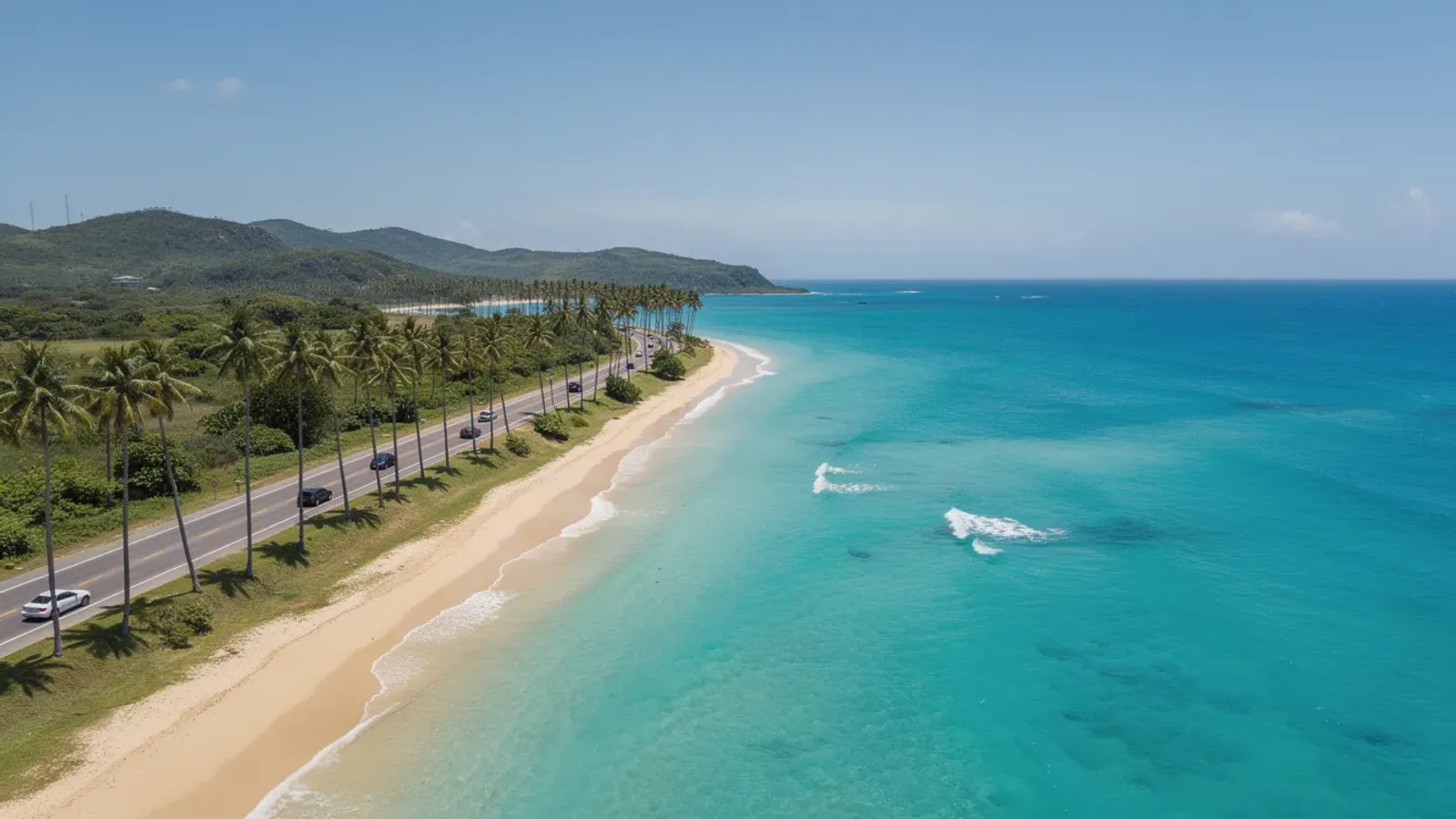
Punta Cana isn’t a town. It’s roughly forty kilometres of coast with resorts strung along it, a small commercial centre inland at Verón, the airport in the middle, and no centre of gravity anywhere.
There’s no tourist bus network. The guaguas exist and they’re wonderful, and they run on a logic of their own that will turn a twenty-minute hop into ninety minutes with a change. Uber works in Bávaro and works badly at the airport, where it behaves like a taxi. So most visitors end up choosing between taxis, pre-booked transfers, packaged excursions, and driving.
| One way from PUJ | Taxi | Private transfer |
|---|---|---|
| Bávaro | $40–55 | $25–45 |
| Cap Cana | $40–50 | $35–40 |
| Uvero Alto | $70–100 | $55–80 |
| La Romana | $100–150 | $80–120 |
Note that taxis here have no meter. The number you’re quoted is an assessment of you, not a tariff, which is why the same route produces two different prices for two couples leaving the rank thirty seconds apart. Agree the figure and the currency before the bags go in.
What a car actually costs
| Class | Low season (May, Sep) | High season (Dec–Mar) |
|---|---|---|
| Economy | $21–35 | $40–55 |
| Medium | $40–55 | $55–80 |
| SUV / crossover | $55–80 | $80–120 |
| Minivan | $70–100 | $95–140+ |
September is the cheapest month in this market and the last two weeks of December the dearest, with roughly 55% between them.
Our own rate for a Kia Picanto is $45 a day for three days, $37 over a week, $30 over two weeks, $25 over a month, and insurance, taxes and unlimited mileage are inside that. Delivery is $20 to the airport or the resort zone.
Then the things that aren’t in any comparison table:
- Fuel. Sold by the litre, pumped by an attendant. Say “lleno”.
- Tolls toward Santo Domingo. About RD$400–600 one way, cash only, no cards at any booth.
- Parking at Montaña Redonda, Hoyo Claro and similar: small, in pesos.
- Child seats. Free with us; $5–15 a day is the market norm elsewhere.
When to skip it, honestly
Four nights inside an all-inclusive with one organised excursion. A car adds nothing and costs $160.
If your resort already includes airport transfers and you’ll book excursions at the desk, your transport is handled. The occasional taxi to a restaurant is cheaper than a week of rental.
If you intend to have a drink with lunch every day, don’t rent. The limit here is 0.05% and roadside checks happen, and the only workable rule on a holiday is that the driver doesn’t drink at all. That’s a genuine reason to skip it, not a disclaimer.
And if driving in unfamiliar traffic makes you anxious, that anxiety will not improve over a week. Some people relax into it on day two; some don’t, and there’s nothing wrong with the second group. The transfers page has fixed prices for exactly that trip.
Where you’d actually go
| From Bávaro | Drive |
|---|---|
| Playa Macao | 25–30 min |
| Hoyo Claro cenote | ~25 min from the airport |
| Higüey, Basílica | ~1 hour |
| Montaña Redonda | ~2 hours |
| Bayahíbe | ~1 hour |
| Altos de Chavón, La Romana | ~1.5 hours |
| Santo Domingo, Colonial Zone | ~2.5 hours on the toll road |
The ones people are most glad they did are Macao at eight in the morning, before the buggy tours arrive, and Santo Domingo as an overnight rather than a day trip. The one people regret is Montaña Redonda in the afternoon, arriving to find two hundred other people queuing for the same swing.
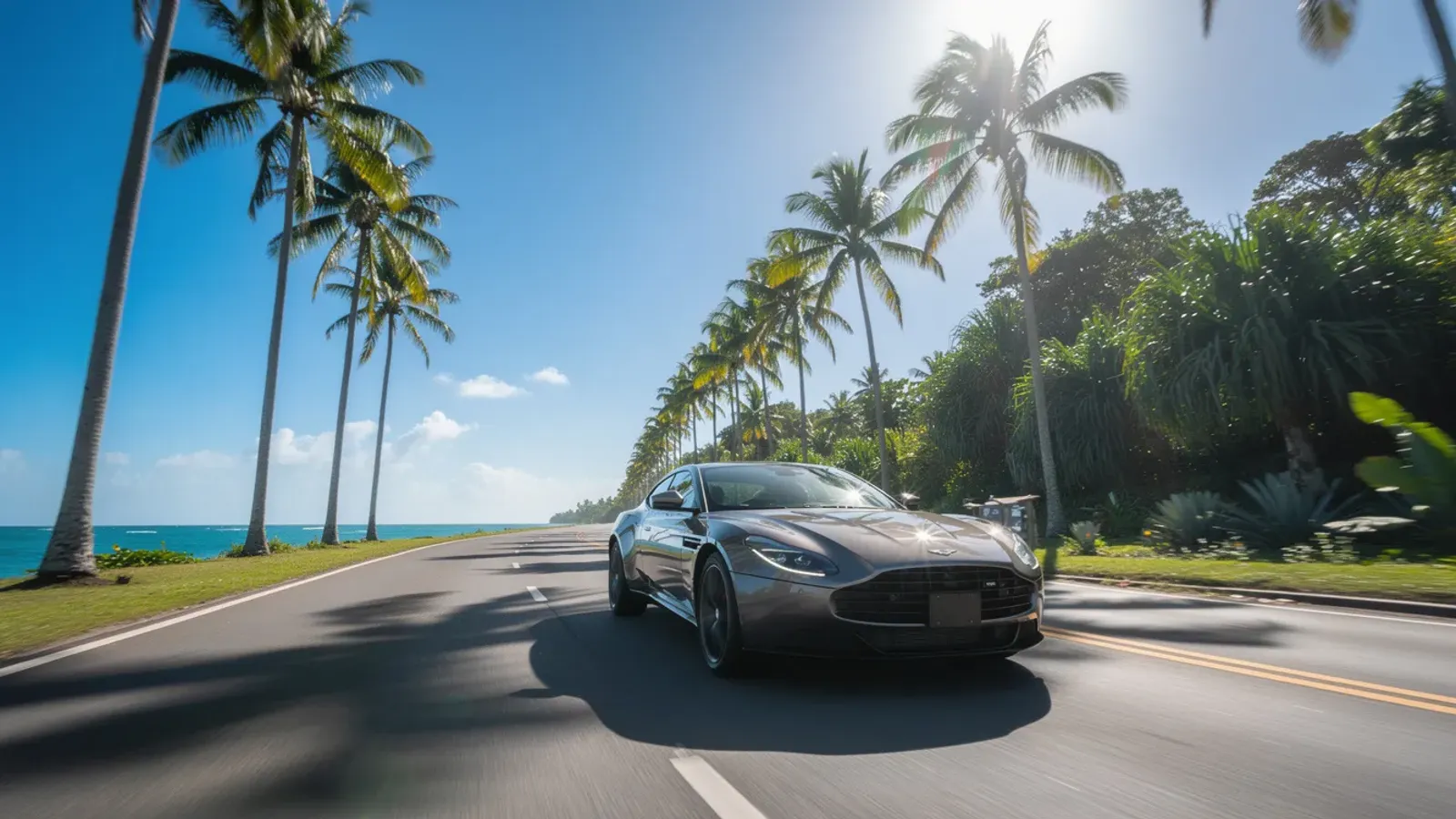 The coastal road near Punta Cana. The main roads really are this straightforward in daylight.
Is it safe
Yes, with adjustments, and the adjustments are specific rather than vague.
The main roads around Punta Cana, Bávaro and Cap Cana are in good condition, and the Autovía del Coral toward La Romana and Santo Domingo is a proper motorway. Daylight driving on those is no harder than driving in southern Europe.
What’s different: motorbikes filter from both sides and pass on the right, so check the right mirror before every right turn. Speed bumps are tall, often unpainted, and frequently sit just past a bend. Pedestrian crossings barely exist outside main junctions, so people cross where they stand. And a short horn blast means “I’m here”, not “I hate you”.
Night driving outside the tourist corridors is the one thing I’d genuinely avoid. Unlit roads, unlit motorbikes, livestock.
On crime: violent carjacking of tourists around the Bávaro corridor is rare. Opportunistic theft from an unlocked or visibly loaded parked car is not. Lock it every time, leave nothing on the seats, use the supervised parking at hotels and malls.
Checkpoints are routine. AMET in town, DIGESETT on the highways. Licence, passport, rental agreement, thirty seconds, on your way. If a fine is raised, ask for the written citation rather than settling at the roadside.
For the longer version there’s a full driving guide.
Documents and the insurance question
You need a passport with an entry stamp under 90 days old and a valid driving licence. Home licences are good here for 90 days. An International Driving Permit is only required if yours isn’t in the Latin alphabet, and you must get it before you travel.
Now the part that costs people money.
Local liability cover is legally attached to the vehicle here, and your credit card does not provide it. Cards may cover collision damage to the rental car, and that cover is nearly always reimbursement-based: you pay for the damage first and claim it back with a police report, contract, invoice and photographs, from a beach, several thousand miles from the insurer.
So ask two numbers, not one. The deposit is what you hand over. The deductible is what you can actually lose, and at plenty of companies here it’s larger than the deposit. Ours are set to the same figure deliberately: $200 on a Kia Picanto or Rio, $300 on SUVs and larger, insurance included in the daily rate.
A credit card isn’t required to book with us, which is worth checking wherever you book, because a card requirement in the main driver’s name is the commonest reason people end up stranded at a counter at PUJ.
Booking
December to April is high season. Christmas, New Year and Easter are the weeks that genuinely sell out, SUVs and seven-seaters first, and for those I’d book two to three months out.
For May or October, two or three days ahead is fine and the panic is manufactured. What booking early actually buys you is the chance to ask the deposit and deductible questions from your kitchen table rather than from an airport queue at midnight.
Two practical things when you do book: send the flight number rather than the landing time, so a delay doesn’t cost you the car, and confirm exactly where the handover happens. Terminal, hotel lobby, or an off-airport office reached by shuttle are three very different arrivals.
Airport specifics are in the PUJ pickup guide.
So: should you?
If you’re leaving the resort three or more times, yes, and it’s not close.
If you’re leaving it once, no, and I’d rather tell you that now than rent you something that spends the week in a car park. Send your dates, hotel and rough plan on WhatsApp and we’ll tell you which of those two you are.
Ready to hit the road?
Rent a car in Punta Cana with no hidden fees — full insurance and unlimited mileage included.
Search cars for your trip