
Traffic fines in the Dominican Republic: what you really pay, and what to do when police stop you
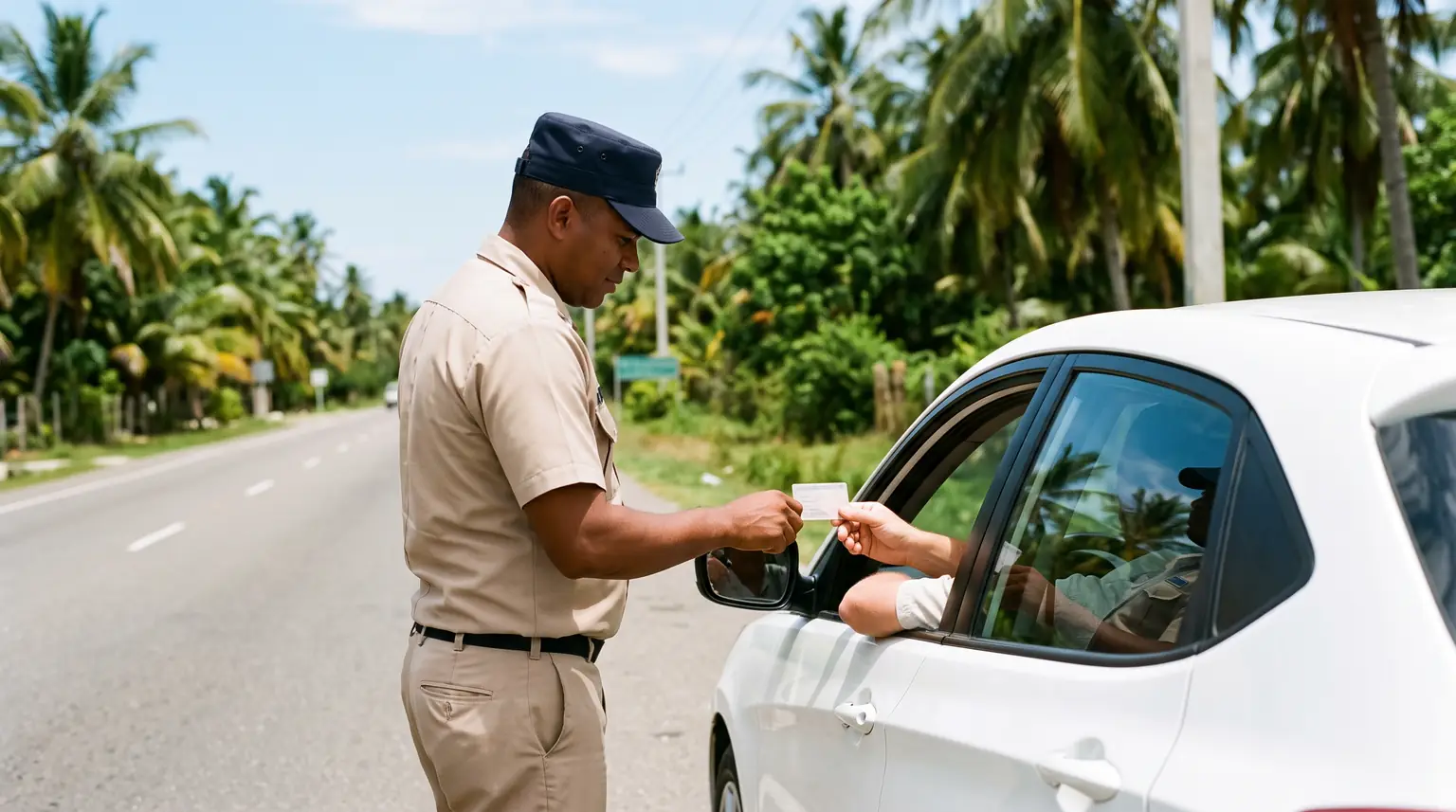
Quick answer. A routine traffic ticket in the Dominican Republic costs between RD$1,000 and RD$1,667, which is about US$16 to US$27. If an officer stops you, ask what article you broke and ask for the official citation, the acta de infracción. Never hand over cash at the roadside. You then have 30 days to pay through multas.pgr.gob.do or at a bank, or to challenge the ticket in court. An ordinary unpaid fine will not stop you flying home.
I have lived in the Dominican Republic for more than twenty years and I run a car rental company in Punta Cana, so I see traffic enforcement from both ends: as a driver on these roads, and as the person a shaken tourist calls from a roadside twenty minutes after being pulled over. I have also taken a traffic ticket worth about twenty dollars to court, and spent two days of my life winning it.
Watch this first
I recorded the short version on video, including the part most guides skip: what the officer is actually asking for when the amount sounds enormous, and what changes the moment you ask for the written citation.
Dominican traffic fines: the short version
| Question | Short answer |
|---|---|
| The law | Law 63-17 on Mobility, Land Transport, Traffic and Road Safety |
| Who enforces it | DIGESETT, the traffic police |
| What you actually pay | RD$1,000–1,667 on the schedule in use, about US$16–27 |
| What the law says on paper | One to three public-sector minimum salaries for most driving offences |
| Cash to the officer | Never. Ask for the acta de infracción |
| Time to pay or challenge | 30 days, article 295 |
| Where to pay | multas.pgr.gob.do, or an authorised bank such as Banreservas |
| Unpaid fine and your flight | Not an exit ban. Only a judge can impose one |
| Serious accident | A different legal situation: detention is possible |
What do Dominican police actually fine people for?
DIGESETT recorded 2,355,349 traffic violations in 2025, against 1,948,238 in 2024, a 20.9% rise, according to figures published by Diario Libre in January 2026. The breakdown tells you where the attention goes.
| Violation | Tickets issued in 2025 |
|---|---|
| Riding without a helmet | 737,789 |
| No licence, or an expired one | 290,617 |
| No insurance, or an expired policy | 224,550 |
| Running a red light | 153,220 |
| No seat belt | 103,156 |
| Driving without lights | 92,357 |
| Speeding | 66,412 |
| Phone or other device at the wheel | 42,727 |
| Driving under the influence | 419 |
Two things jump out of that table. Most enforcement is aimed at motorbikes, which is not your problem in a rental car. And the offences that do concern you are mundane: a belt, a phone, a red light, a document you left at the hotel.
The speed limits you are actually held to
Posted signs always win. Where a road has no posted limit, article 268 of Law 63-17 fills the gap, and these defaults are the numbers an officer can hold you to.
| Where you are driving | Default limit |
|---|---|
| Residential streets | 30 km/h |
| Urban avenues | 60 km/h |
| Rural roads | 60 km/h |
| School, church and cemetery zones | 20 km/h |
| Tunnels, flyovers and underpasses | 60 km/h |
| Highways and motorways | Set by the ministry, never above 120 km/h |
| Toll plazas | 10 km/h in the paying lane, 40 km/h in the others |
The toll line matters on the drive to Santo Domingo, where people roll through the cash lane far faster than walking pace. Speeding carries a fine of one to three minimum salaries plus licence points under the same article, and the highway ceiling of 120 km/h is a maximum the ministry may set for a given road, not a permission that applies everywhere on it. That last distinction is the single most common misreading of the law I hear from visitors, usually somewhere on the Coral highway with the sea on one side and nothing posted for ten kilometres.
Follow the sign. Not the table.
Belts, phones and red lights
Article 231 forbids driving or carrying passengers without a seat belt. It names no amount, which means article 281 fills in the default: one public-sector minimum salary. Back seats are not exempt, and the 103,156 belt tickets written last year suggest the rule is enforced rather than decorative.
Article 221 covers distraction. Holding a phone, texting or filming while driving is a fine of one to three minimum salaries plus points, while hands-free use is explicitly allowed. Set your route before you pull away and use a mount. Red lights produced 153,220 tickets in 2025, and more to the point, a green light here is a statement about your lane, not a promise about anyone else’s.
Documents: the fine that turns into a court trip
Keep your licence, the rental agreement and the car’s insurance paperwork where you can reach them without emptying your bag. This is the one category where a stop stops being a ticket.
Article 291 lets the officer take a driver directly to the competent court, rather than writing a citation, in three situations: driving without a licence or unable to produce one, driving without valid insurance or technical inspection, or causing an accident with injuries. When you collect a rental car, confirm that the insurance and the marbete are current and in the glovebox. Our own guide to driving in the Dominican Republic covers the rest of what travels in the car.
Yes, you can be fined for driving too slowly. It happened to me
Article 269 prohibits driving, without justification, so slowly that it obstructs the normal and reasonable movement of traffic. The penalty is the same one to three minimum salaries as speeding.
Some time ago an officer wrote me that exact ticket. I did not agree that my driving fitted the description, and the amount was about twenty dollars, so the sensible thing was to pay and forget it. I challenged it instead, spent two days travelling to court and presenting my position, and the court cancelled the ticket.
As an investment of time it was terrible. As a principle it was worth it, because it taught me the thing worth passing on: a citation is not automatically correct because an officer wrote it. It is an accusation, in writing, which a court can review. That is also the best argument for insisting on the written citation in the first place. Without it there is nothing to examine, nothing to dispute, and no record that anything happened at all.
Would I tell a visitor with six days of holiday to do the same? No. Two days in a Dominican courthouse costs far more than the fine.
How much is a traffic fine in the Dominican Republic?
This is where most guides, and most arguments at the roadside, go wrong.
Law 63-17 ties penalties to the minimum salary of the centralised public sector. That salary was RD$5,117 when the law passed in 2017 and rose to RD$10,000 in 2019, so a fine of one to three salaries would mean RD$10,000 to RD$30,000, and the heaviest categories in the law reach fifty salaries, about half a million pesos.
Nobody pays that.
DIGESETT still issues fines from a schedule updated in 2016, where the amounts are RD$1,000 and RD$1,667. Diario Libre reported in March 2025 that in eight years no authority has explained why the law’s own amounts are not applied. Tobías Crespo, the deputy who wrote the law, put it down to political reasons; he has twice filed a bill to cut the figures, most recently proposing a range of RD$2,500 to RD$17,500, and the presidents of both chambers backed the latest attempt.
| On the ticket today | In Law 63-17 | |
|---|---|---|
| Common violations | RD$1,000–1,667 (US$16–27) | 1–3 minimum salaries, RD$10,000–30,000 |
| Most serious categories | Still the 2016 schedule | Up to 50 minimum salaries, about RD$500,000 |
So the practical answer for a visitor is US$16 to US$27 per ticket at the current rate of about RD$61 to the dollar, with a reform pending in Congress that could change it. Read the amount printed on your own citation and treat any other number, from a website or from a person, as a claim to verify.
What to do when traffic police stop you
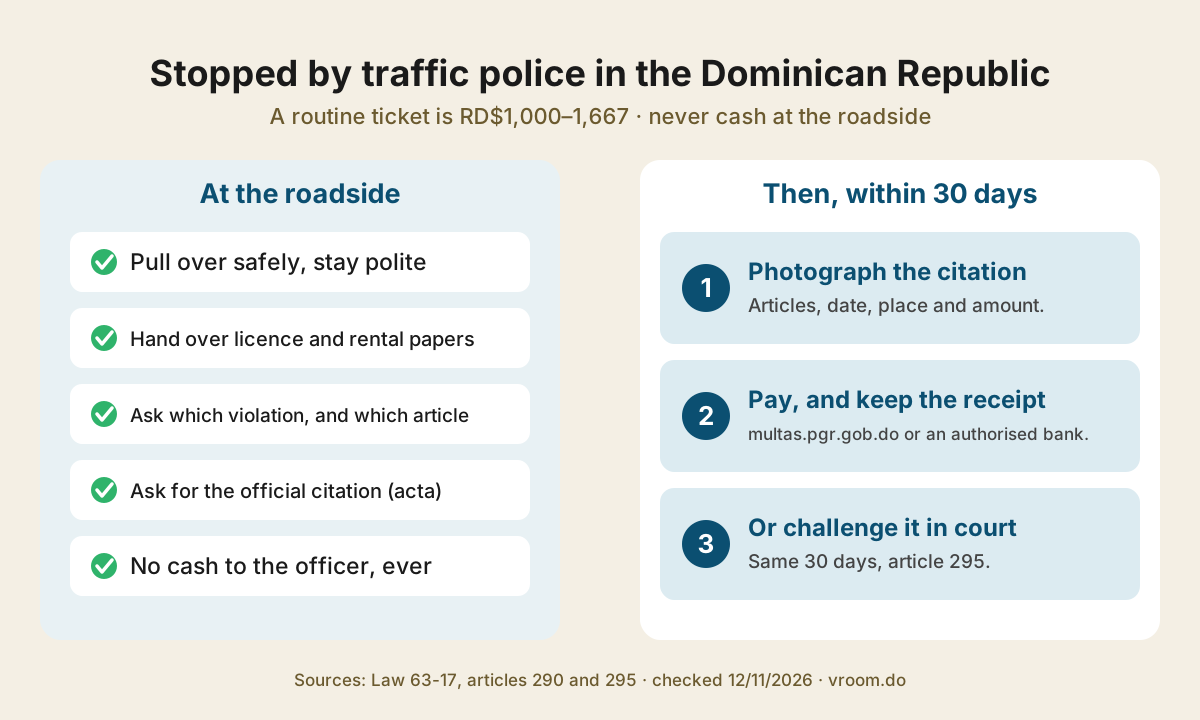
Most stops here are routine and end in a couple of minutes. The sequence that keeps them that way:
- Pull over safely when an officer signals you to.
- Stay calm and polite. Greet them in Spanish even if that is where your Spanish ends.
- Hand over the documents you are asked for.
- Ask which violation you are accused of, and which article it falls under. Article 290 requires the officer to write the violated articles on the citation, so the question is a normal one.
- If a violation is alleged, ask for the official citation.
- Read what is written on it before you drive away, and photograph it.
- Call your rental company if anything is unclear. That is what we are for.
Useful Spanish for a traffic stop
| English | Spanish |
|---|---|
| Good morning, officer. | Buenos días, agente. |
| Why have you stopped me? | ¿Cuál es el motivo de la detención? |
| What violation did I commit? | ¿Qué infracción cometí? |
| Which article of the law is that? | ¿Qué artículo de la ley es ese? |
| Please give me the official ticket. | Por favor, entrégueme la multa oficial. |
| Where can I pay the fine? | ¿Dónde puedo pagar la multa? |
| I would like to call my rental company. | Quisiera llamar a mi compañía de alquiler. |
| I do not agree with this violation. | No estoy de acuerdo con esta infracción. |
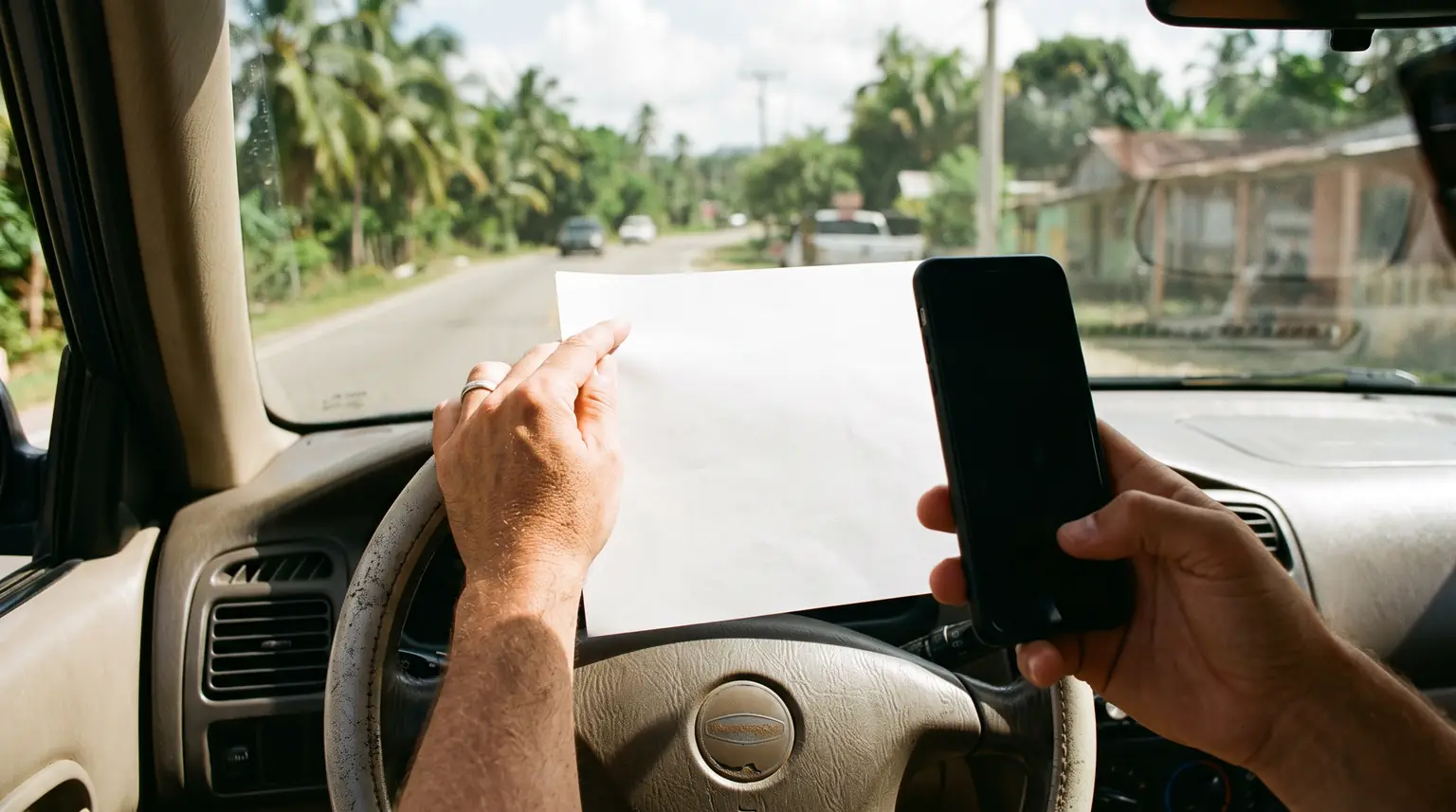
What if the officer asks for cash?
Most officers do their job properly. Still, every rental company here knows the pattern, and you should recognise it.
A tourist is stopped for something minor. The officer explains that the fine has to be paid at a bank. Then comes the complication: tomorrow is Sunday, the banks are shut, and the flight home leaves Monday morning. The problem, it turns out, can be solved immediately, in cash, for a hundred or two hundred dollars.
The tourist is tired and nervous, and pays.
The arithmetic is the giveaway. The citation behind that conversation is the same RD$1,000 to RD$1,667 as everyone else’s, around twenty dollars. I have seen visitors hand over ten times the real amount to avoid a piece of paper that would have cost them twenty minutes online.
Three reasons never to do it. Offering money to a public official is a criminal matter, and you are the foreigner in that transaction. The amount asked for is usually many times the fine. And a cash payment leaves you with no proof of anything: no receipt, no citation, no record that the accusation was resolved.
The US State Department advises citizens who are asked for a bribe to refuse politely and request an official ticket, and the UK and Canadian advisories say the same. There is also a practical change on the ground: under the RD se Mueve programme launched in 2025, around 700 agents were issued body cameras. Asking for the written citation is no longer an awkward request. It is the normal one.
Can an unpaid ticket stop you leaving the country?
No. An ordinary unpaid traffic ticket is not an exit ban. No officer can decide on their own that you may not board a flight.
The Constitutional Court restated the principle on 12 November 2025 in decision TC/1186/25. The case was about tax law, not traffic: the court struck down the clause of the Tax Code that let the migration authority stop someone leaving merely because they were under investigation for suspected tax fraud. The reasoning is what travels. Freedom of movement is protected by article 46 of the Constitution, and under article 40.1 a judge is the only authority who can impose a measure preventing a person from leaving the national territory.
What an unpaid fine does do is block Dominican paperwork. Article 281 says that until the fine is paid, the driver cannot renew a licence or plates, pass the technical inspection, arrange vehicle insurance, obtain a good-conduct certificate or transfer ownership of a vehicle. That bites if you live here. It has nothing to do with your boarding pass.
If someone tells you otherwise at the airport, stay calm and ask for the legal basis in writing. If there genuinely is a court order or a criminal investigation, that is not a ticket, and you need a lawyer rather than an argument.
How to check and pay a traffic fine
The official portal
The Attorney General’s Office runs the traffic fine lookup at multas.pgr.gob.do. You open the site, enter your identity document, review whatever appears under it and pay.
In theory that is the whole process. In practice I have tried it several times and have yet to complete a payment: government portals here change, fail and come back. Try it first anyway, and if it will not load or will not take the payment, go to a bank. Also, do not read an empty result as good news. A citation written yesterday may simply not be in the system yet.
At the bank
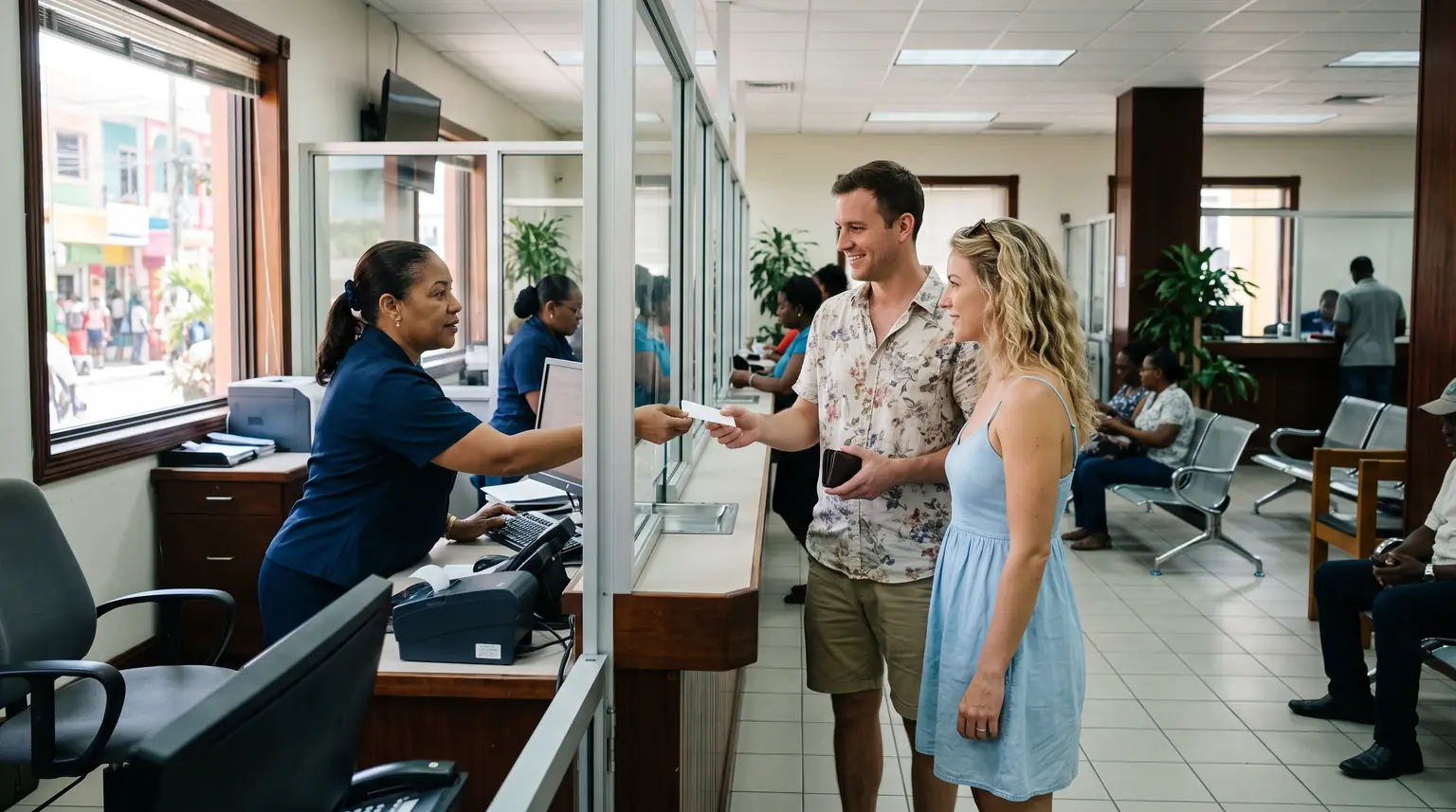
Banreservas is the state bank, it has branches in every sizeable town, and it has handled traffic fine payments for years. Call the branch or ask at the counter first, because not every location takes every type of payment. Bring the citation, your passport, the número de acta from the ticket and a payment method. Keep the receipt until the fine disappears from the portal.
Can I pay at the airport?
Do not plan on it. Traffic fines are settled through the official channels, not at a check-in desk, and they are not the same thing as an immigration overstay fee, which is a separate payment handled by migration.
How to challenge a traffic ticket
Article 295 gives you 30 days from the citation either to pay or to contest it. A formal challenge goes directly to the competent court. If you do neither within those thirty days you are declared in default and collection passes to INTRANT or the Attorney General’s Office.
If you intend to dispute it, collect the evidence the same day:
- A photograph of the citation, including the articles the officer listed.
- The date, time and exact location.
- Photographs of the signs or road markings that matter.
- Dash-cam footage, if you have it.
- Names and contact details of any witnesses.
Do not argue at the roadside. The officer cannot cancel the citation, and the court is where the facts are weighed. For a visitor the honest calculation is usually the one I made in reverse: compare the fine with two days of your holiday.
What happens after an accident with injuries
This is a different legal world from a ticket, and it is worth understanding before you need it.
When a crash involves deaths, injuries or damage to property, article 26 requires the DIGESETT agent to raise an acta and send it to the Public Ministry, and article 291 allows the driver to be taken directly to court. A driver can be held while responsibility is established, which is exactly what the US State Department warns about. Article 304 also lists the circumstances that aggravate the outcome: phone use, speeding, running a red light, alcohol or drugs, racing, no technical inspection, no insurance. And if it does happen, the order of the first ten minutes is fixed: stop, check whether anyone needs help, call 911, notify your rental company and the insurer, follow the officers’ instructions, and ask for legal assistance rather than improvising a statement in a language you half speak.
Being a tourist exempts you from none of it.
Casa del Conductor, and why I would check for it before I signed
Casa del Conductor is a 24-hour driver assistance service with locations in Santo Domingo and Santiago. If a member is detained after a road accident anywhere in the country, they are moved to the service’s own premises and housed in a private room with its own bathroom and meals while the legal process runs, instead of an ordinary detention facility. The service also provides independent legal advice, accident reporting and on-site fine payment. It does not erase criminal responsibility and it does not overrule a judge.
Most travellers ask only about scratches and deductibles when they rent a car. The question worth adding is: does this rental include Casa del Conductor or an equivalent?
Our cars are insured with MAPFRE and include Casa del Conductor coverage, which you can read about on our company page, alongside our guide to rental car insurance and deductibles here. Coverage always depends on the policy terms, eligibility and the law, and the moment to establish what you have is before the keys change hands.
Checklist before you leave the hotel
- Driving licence and passport, or a copy of the passport, in the car.
- Rental agreement, insurance paperwork and marbete in the glovebox.
- Everyone belted, back seats included.
- Route set on the phone before you move, phone in a mount.
- Rental company’s emergency number saved in your contacts.
- You know the phrase entrégueme la multa oficial.
- You know that a fine is RD$1,000–1,667, not two hundred dollars in cash.
- You know whether your rental includes accident assistance.
Frequently asked questions about Dominican traffic fines
How much is a traffic fine in the Dominican Republic?
In practice DIGESETT still issues fines from the 2016 schedule: RD$1,000 and RD$1,667, roughly US$16 to US$27. Law 63-17 sets much higher penalties, counted in public-sector minimum salaries, but those amounts have never been applied. Check the figure printed on your own citation.
Can I pay a traffic fine in cash to the officer who stopped me?
No. Ask for the official citation, the acta de infracción, and pay through the Attorney General’s portal at multas.pgr.gob.do or at an authorised bank. An officer who wants cash at the roadside is not collecting a fine.
What is the fine for not wearing a seat belt in the Dominican Republic?
Article 231 of Law 63-17 bans driving or carrying passengers without a seat belt but sets no separate amount, so article 281 applies: one public-sector minimum salary on paper. In practice the figure written on the ticket comes from the old schedule, around RD$1,000.
What is the speed limit in the Dominican Republic?
Posted signs come first. Where nothing is posted, article 268 sets 30 km/h in residential streets, 60 km/h on urban avenues and in rural areas, 20 km/h in school zones, 60 km/h in tunnels and underpasses, and up to 120 km/h on highways. Toll plazas are 10 km/h in the paying lane and 40 km/h in the others.
Can an unpaid traffic ticket stop me leaving the Dominican Republic?
Not by itself. Only a judge can order a measure that prevents someone from leaving the country, a principle the Constitutional Court restated in decision TC/1186/25 of 12 November 2025. An unpaid fine blocks local paperwork such as licence renewal, not your flight home.
How long do I have to pay or challenge a Dominican traffic fine?
Thirty days from the citation, under article 295 of Law 63-17. In that window you either pay or file a formal challenge directly with the competent court. Do neither and you are declared in default, and INTRANT or the Attorney General’s Office proceeds with collection.
Can I check Dominican traffic fines with my passport number?
The Attorney General’s portal at multas.pgr.gob.do searches by identity document and supports passport numbers where the record carries one. I have tried it several times without completing the process, so leave time for the bank as a fallback.
Can I be fined for driving too slowly in the Dominican Republic?
Yes. Article 269 bans driving unjustifiably slowly when it obstructs normal traffic, with a penalty of one to three minimum salaries plus licence points. I received that ticket myself, challenged it in court and won.
Will my rental company pay my speeding ticket?
No. Traffic violations committed during the rental are the driver’s responsibility. Tell your rental company anyway if you are stopped: we can explain the paperwork and the payment route in Spanish.
What is Casa del Conductor and why does it matter in a rental car?
It is a 24-hour driver assistance service. If you are detained after a road accident, it moves you to a private room with its own bathroom and meals while the legal process runs, and provides independent legal advice. Our rentals include MAPFRE insurance and Casa del Conductor coverage.
Know the rules, not just the roads
A car here opens up the country: the mountains, the small towns, the coast road that no excursion bus takes. What spoils that is not the traffic police. It is arriving unprepared at a two-minute conversation and treating it as an emergency.
Respect the limits, keep the documents within reach, ask for the citation, and pay the twenty dollars through the proper channel. If the accusation is wrong, the law gives you thirty days and a court. My own ticket took two days and I would rather have spent them on the road to Samaná, but I know what the paper in my hand is worth now.
If you are planning to drive here, our cars and rental terms are all on one page. And if you have ever been stopped in the Dominican Republic, tell us what happened. The next traveller is reading.
This article is general information, not legal advice. Fine amounts, procedures and insurance conditions change. Check your citation and, where it matters, ask a Dominican lawyer. Exchange rate used: RD$61 to US$1, 12 November 2026.
Ready to hit the road?
Rent a car in Punta Cana with no hidden fees — full insurance and unlimited mileage included.
Search cars for your trip