
Rent a car or book a tour in Punta Cana? Seven destinations, and what I would actually do
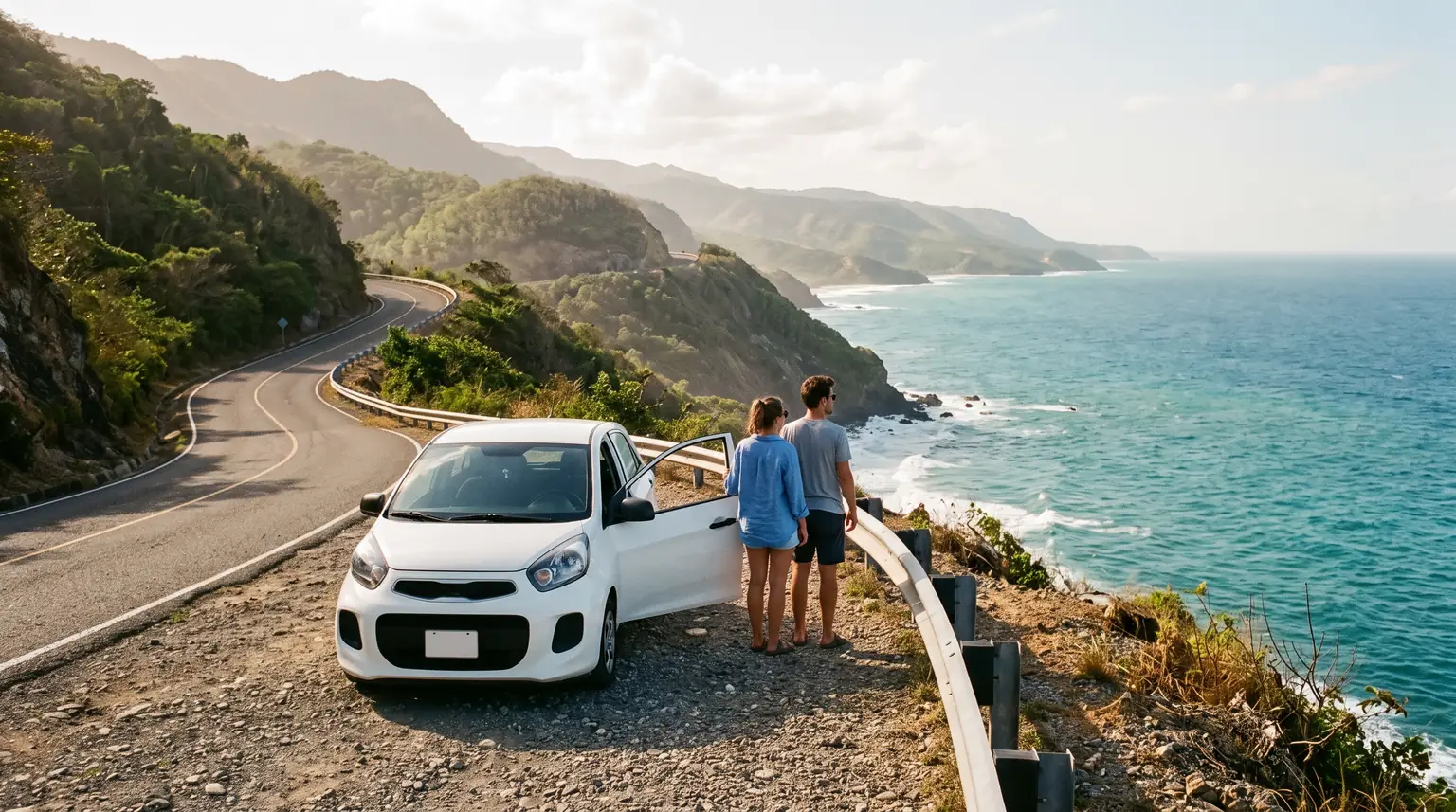
Quick answer. Rent a car when you want to go where the buses do not: Las Terrenas, Jarabacoa, Barahona, Sosúa, the Baní dunes, or any trip of two days or more. Take an organised excursion for a one-day Saona, a one-day Samaná or a history-focused Santo Domingo. For one day on Saona, a group tour starts at $69 per person against roughly $133 per person if two of you drive yourselves.
I have lived in the Dominican Republic for more than twenty years and I own a car rental company in Punta Cana, so you might expect the answer to be “rent a car” every time. It is not. Quite often the honest advice is to leave the keys alone for a day, and driving to Bayahibe just to catch a boat to Saona is the clearest example: it costs more than a good excursion and buys you a long drive home.
Where a car does change the holiday is everywhere the excursion buses skip. Here is how I would choose, destination by destination.
Car rental or excursion: the short version
| Destination | What I would do | Why |
|---|---|---|
| Saona Island | Excursion | The last leg is by boat anyway; transfer, lunch and drinks come bundled |
| Samaná, one day | Excursion | Eight to ten hours of driving to see a waterfall |
| Samaná, 2–3 days | Rental car | Las Terrenas, Playa Bonita, Cosón at your own pace |
| Santo Domingo, history | Guided excursion | A good guide is worth more than a parking space |
| Jarabacoa | Rental car | Mountains, waterfalls, cabins you choose yourself |
| Barahona, 2–3 days | Rental car | A coastline to stop along, not a single attraction |
| Sosúa and Cabarete | Rental car | Several beaches and towns in one trip |
| Baní and Las Salinas | Rental car | Dunes and salt flats no group bus visits |
This assumes you are based in Punta Cana or Bávaro. From Bayahibe, Santo Domingo or Samaná the maths changes completely.
1. Saona Island: take the excursion
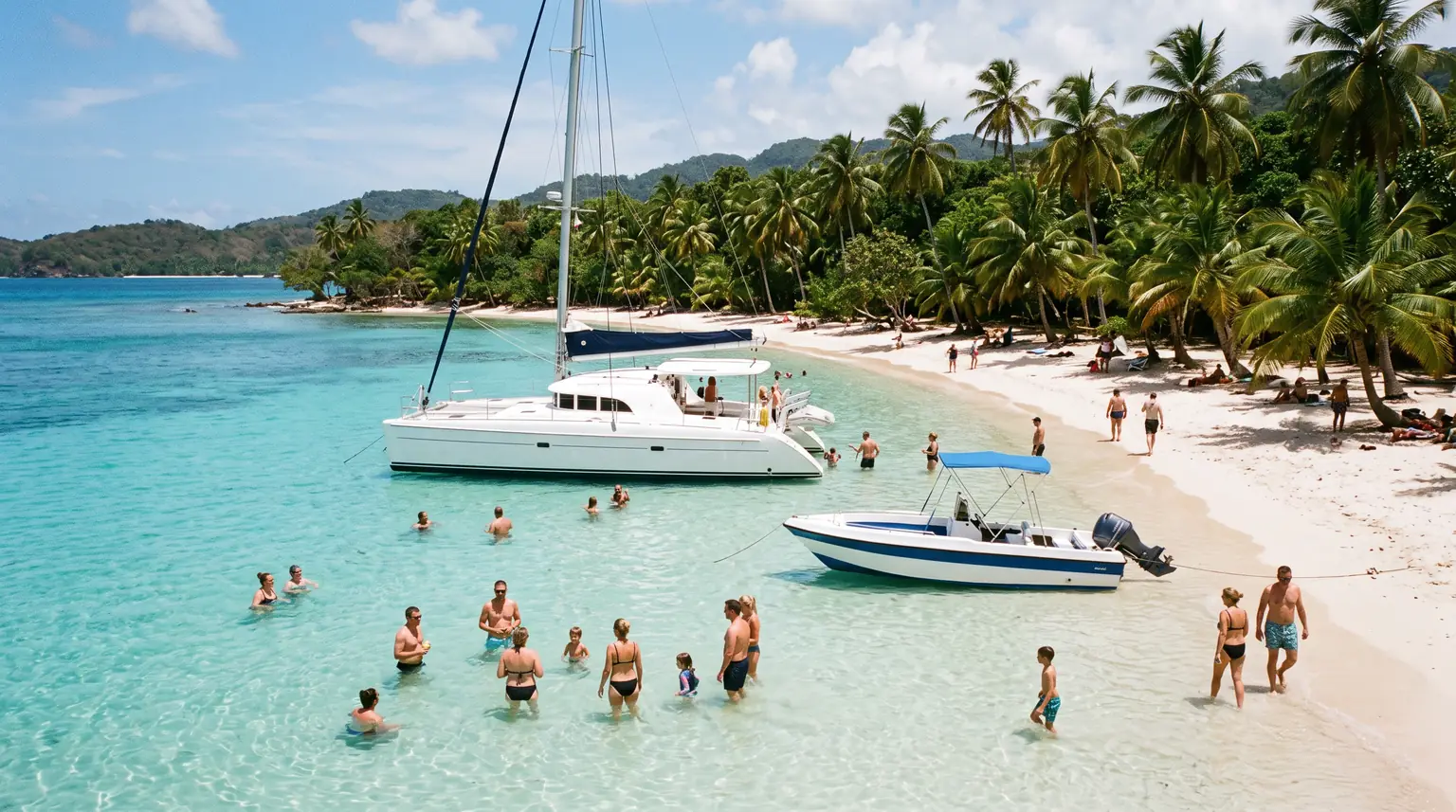
You cannot drive to Saona. It sits inside Cotubanamá National Park, and every version of the trip ends with a boat from Bayahibe, a fishing village 60 to 90 minutes from Punta Cana depending on your hotel and the traffic.
You can of course organise it yourself: drive to Bayahibe, park, find a boat operator and negotiate. The departure area is busy with several groups arriving at once, and the cheapest offer on the dock rarely explains which beach you are going to, how long you get there, or what the lunch actually is.
Possible is not the same as sensible.
What a do-it-yourself Saona day costs
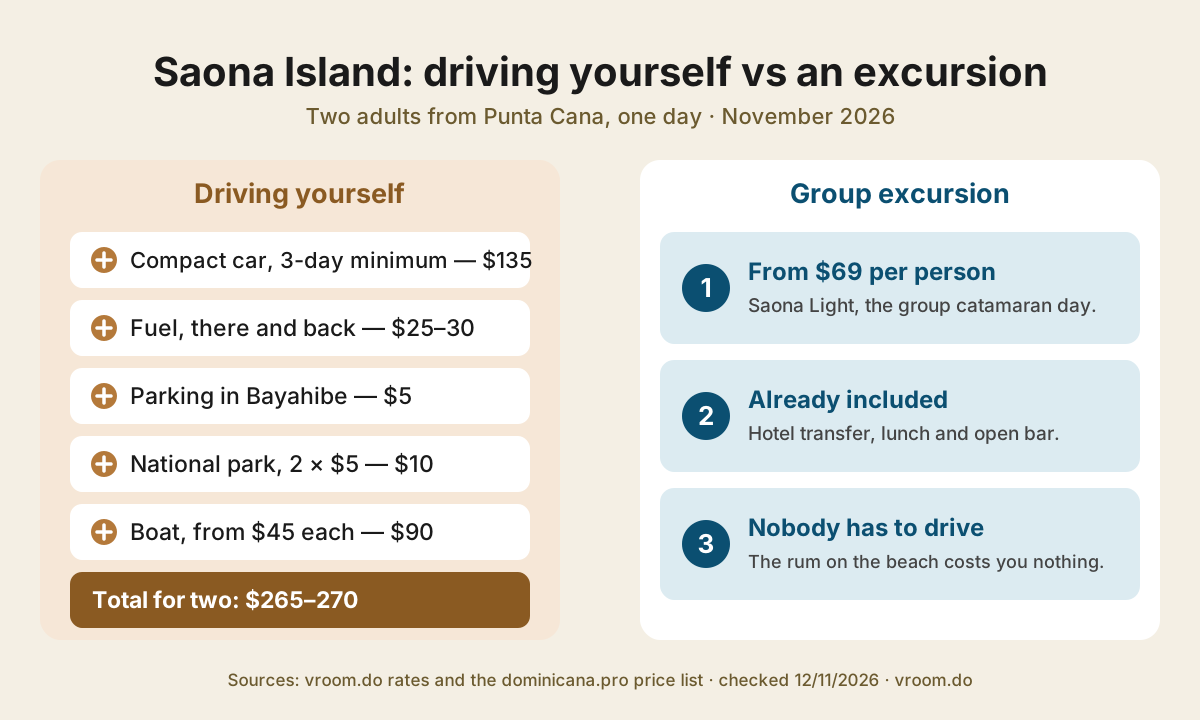
Two adults, one day, leaving from Punta Cana:
| Expense | Estimate |
|---|---|
| Compact car, one day of use | $45 |
| Fuel, there and back | $25–30 |
| Parking in Bayahibe | $5 |
| National park entry, about $5 each | $10 |
| Boat trip, from $45 each | $90 |
| Total for two | $175–180 |
These are planning estimates rather than quotes; the park fee is sometimes already inside the boat price, and two boats at the same dock can offer very different days.
There is also a detail most comparisons miss. Our compact cars start at $45 a day, but the minimum rental is three days. Rent a car purely for this one trip and the vehicle line is $135 rather than $45, which pushes the day to roughly $265–270 for two people, about $133 each.
Now look at the other side. On Dominicana PRO the group Saona day starts at $69 per person with the catamaran, lunch and open bar included; the livelier speedboat version is $95, and a small-group day with Altos de Chavón and a floating bar is $169. Private boats start around $628. A group excursion is not just competitive with the DIY version — for two people it is cheaper, and nobody drives.
And then there is the rum
You are in the Caribbean, on a beach, and someone hands you a glass of Brugal. On an excursion with hotel pickup that is a pleasant afternoon. If you drove, it is a problem.
Drink-driving is article 256 of Law 63-17, and the penalty is heavier than for ordinary offences: five to ten public-sector minimum salaries plus licence points, with the car potentially held. We wrote up how fines actually work in traffic fines in the Dominican Republic. For a beach day that involves a bar, the excursion is the cheaper decision before anyone has done anything wrong.
When driving yourself to Bayahibe does make sense
One real advantage: time. Big group tours can spend an hour collecting passengers from six hotels, and some add a souvenir stop you did not ask for. Driving means you skip all of that and pick your own boat.
But a small-group excursion buys the same thing with less effort. Compare those before you decide the car is the answer.
My recommendation: for most people staying in Punta Cana, book a Saona excursion with clearly stated inclusions. If the pickup route is what bothers you, compare the small-group and private formats rather than driving.
2. Samaná: excursion for a day, car for three
Samaná is the Dominican Republic people do not expect: green hills, waterfalls, fishing villages, and beaches that look nothing like the resort strip. The catch is distance. Four to five hours each way from Punta Cana, depending on the route.
For one day, that maths is brutal.
Leave before sunrise, drive five hours, then work out where to park for El Limón waterfall, how to reach a beach, where to eat — and drive five hours back, tired, in the dark, on roads you met once. An organised day handles the logistics and often mixes road and boat transport; the group Samaná day starts at $120 per person, and the version that includes humpback whales in the bay runs from $135 in season, from 1 January.
Give the peninsula three days and everything inverts. Drive to Las Terrenas, check into a beachfront hotel, and spend the next day on Playa Bonita or Playa Cosón with no schedule at all. That is a trip a car genuinely improves.
Which car for Samaná
The main roads are paved and a normal car reaches Las Terrenas. Some secondary roads and hotel access tracks are rougher than anything around Punta Cana, so I would rather send you up there with some ground clearance: the Kia Carens or the Suzuki XL-7, both $85 a day, both seven seats.
Neither is a 4×4, and ground clearance does not make a bad road safe. If your hotel is at the end of a dirt track, ask us about the last kilometre before you drive it.
3. Santo Domingo: pay for the guide, not the parking
The Colonial Zone is a UNESCO World Heritage Site, and the detail worth knowing is what UNESCO itself records: the settlement began on the east bank of the Ozama in 1496, Bartholomew Columbus founded the city in 1498, and in 1502 Governor Nicolás de Ovando moved it to the west bank and laid it out on the grid that became the model for town planning across the New World. The first cathedral, the first university, the first hospital and the first customs house in the Americas are all here, inside 106 hectares and 116 blocks.
The history is better than the postcard. In 1586 Francis Drake took the city and held it for ransom, 25,000 ducats, as the Library of Congress records. On 3 September 1930 the eye of hurricane San Zenón passed directly over a capital of some 70,000 people; Diario Libre puts the toll around 2,000, many of them killed after they walked outside during the calm of the eye believing the storm had passed. Trujillo had been in power for two weeks and had the dead burned and buried in a mass grave on what is now plaza Eugenio María de Hostos.
None of that is visible from a parking space. Without a guide, the Colonial Zone is handsome old buildings. With one, it is privateers, a ransom, a dynasty and a dictatorship, on the actual streets where it happened. The city tour runs from $95 per person in a group, and private versions from $424.
Driving there is easy enough, two and a half to three and a half hours. Parking and traffic in the capital are the least enjoyable part of anyone’s day. If Santo Domingo is one stop on a longer route west, bring the car, park at the hotel, and still take a walking tour of the Colonial Zone.
4. Jarabacoa: the drive is the point
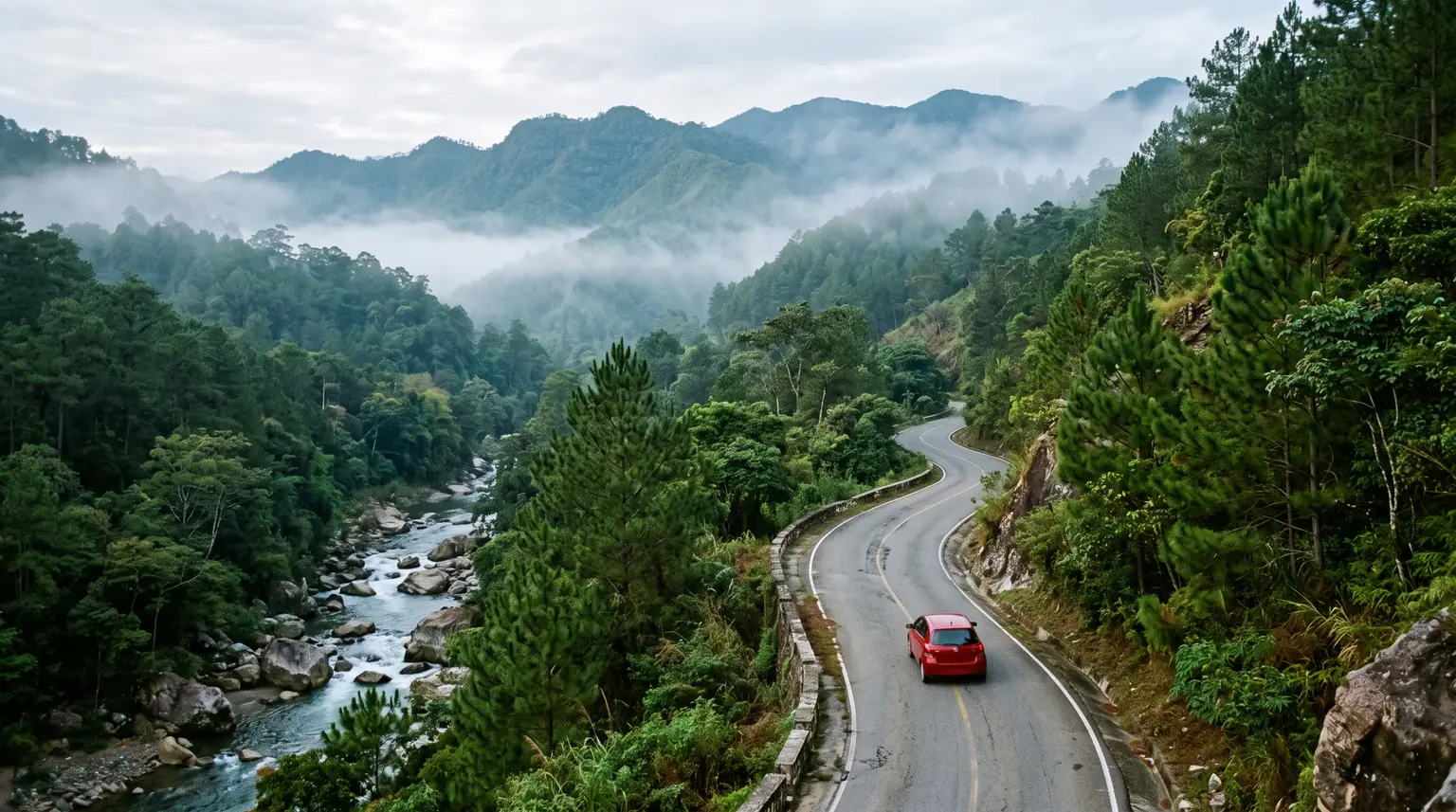
If you think this country is only beaches, Jarabacoa will change your mind. Pine forest, rivers, waterfalls, cool nights, a climate that earned it the nickname City of Eternal Spring. Four to five hours from Punta Cana, so not a day trip: plan one night, better two.
Salto Jimenoa is the waterfall everyone photographs. The Yaque del Norte is where the rafting happens. Beyond that it is mountain cabins, coffee, viewpoints and roads with nothing commercial on them — the kind of place where the freedom to stop is the whole value.
A compact car handles the main paved routes. Some cabins sit at the end of steep or broken access roads, so for a family I would again take the Carens or the XL-7 and check the final approach with the hotel. On genuinely bad or very steep tracks, four-wheel drive or a local lift is the answer, not optimism.
5. Barahona: the road trip almost nobody takes
The southwest is where the mountains fall straight into the Caribbean, and it is the part of the country international visitors most often never see. Five to six hours from Punta Cana, which is exactly why I would not try to do it and come back in one day. Three days, minimum.
Playa San Rafael, where cold mountain water meets the sea in natural pools, and Playa Los Patos are the famous stops. Further south there are coastal landscapes and small communities that appear in no excursion catalogue at all.
Barahona is not an attraction, it is a region, and the best version of it comes from stopping whenever something is worth stopping for. A fixed group schedule removes the entire point. Two warnings: not every beach here is for swimming — some have strong currents, steep shelves or rocky entries, so follow local advice — and plan your days so you are not meeting unfamiliar mountain roads after dark.
6. Sosúa and Cabarete: a different coast
The Atlantic north coast is a different country from Punta Cana. Sosúa has a sheltered bay with clear water; Cabarete, a few minutes away, is a surf and kiteboarding town with beach restaurants and a looser, more independent feel. Five to six hours of driving from Punta Cana.
This is a three-day trip at least: a day in Sosúa, a day in Cabarete, perhaps Puerto Plata and the cable car. Between them are beaches and viewpoints that need your own transport to reach. Ocean conditions differ sharply between the two towns, so check local swimming advice rather than assuming the Caribbean behaves the same everywhere. A compact or midsize car is enough if you stay on the main roads.
7. Baní: mangoes, dunes and salt flats
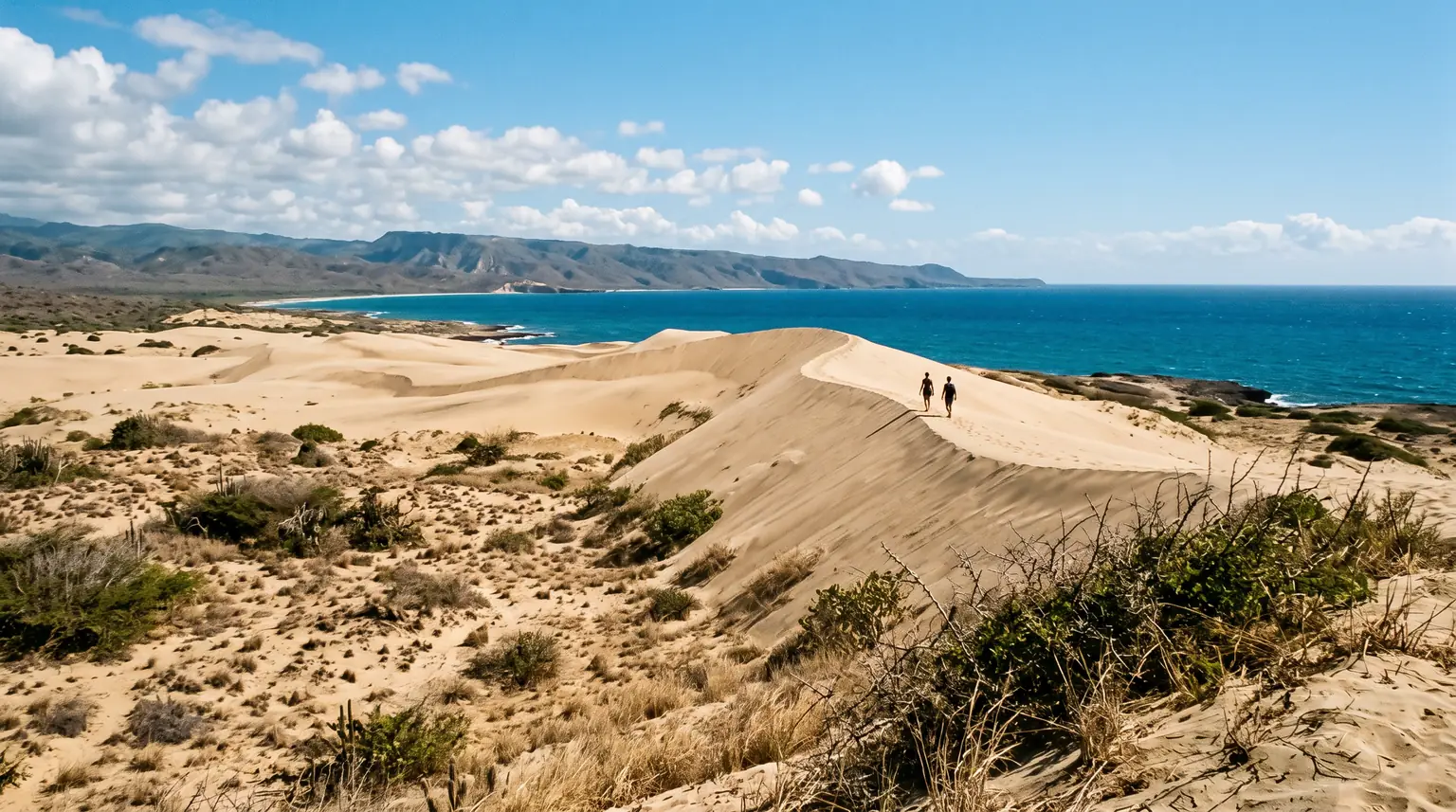
West of Santo Domingo, in Peravia province, Baní got an official title in 2025 that tells you what it is about: Law 36-25 declared it the Mango Capital of the Dominican Republic, and the town’s Expo Mango is a serious agricultural fair rather than a tourist show.
The surprise is the landscape. Near Las Calderas lie the Dunas de Baní, a coastal dune field that runs across the peninsula with dunes reaching about 35 metres, according to the Dominican film commission. It is not the Sahara, but standing in dry scrub and sand with the Caribbean behind you is not what anyone expects from this island. The salt pans around Las Salinas add another strange view; the water sometimes takes a pink tinge, which depends on salinity, microorganisms and light, so do not go expecting the saturated pink of edited photographs.
No resort bus comes here.
That is the appeal, and it is also the practical constraint: three and a half to four and a half hours from Punta Cana makes Baní an overnight stop rather than a day trip, best combined with the capital or taken as the first leg of a southern route toward Barahona.
So what does a road trip actually cost?
The usual mistake is comparing an excursion price per person with a car price per day. The car is not the trip. Fuel, tolls, parking and the number of days all belong in the same column.
Two travellers, compact car at $45 a day:
| Expense | Estimated total |
|---|---|
| Three-day rental | $135 |
| Fuel | $60–90 |
| Tolls and parking | $20–40 |
| Transport total | $215–265 |
| Per person | $107.50–132.50 |
Accommodation, food and entry fees are on top, and a long run to the north coast or the southwest will sit at the upper end. But notice what happens with four people in the same car: transport falls to roughly $54–66 each, for three days and as many destinations as you can fit. That is why rental cars suit families and small groups, and why a solo traveller doing one beach day is usually better off on a tour.
The question is never only which is cheaper. It is what each price includes. An excursion price contains the driver, the guide, the boat, the lunch and the entry tickets. A rental price contains a car, insurance and taxes — and the rest of the day is yours to organise.
Driving here: what to know before you decide
Both options are fine when organised properly, but Dominican roads ask for a different kind of attention: motorbikes passing on both sides, livestock, unlit secondary roads, and pedestrians who expect you to see them. If you have only ever driven in North America or Europe, the first hour feels busy.
If you take the car:
- Drive in daylight when you can, especially on unfamiliar mountain or coastal roads.
- No alcohol at all if you are driving. See article 256 above.
- Keep licence, rental agreement and insurance papers in the car.
- Set the route before you move and use a phone mount.
- Give motorbikes room, and expect them where they should not be.
- Avoid remote roads after heavy rain.
- Know what your insurance covers and what the deductible is — ours is explained in rental car insurance and deductibles.
- Tell us where you are going. Long trips to Barahona or the north coast are fine, but we will tell you what assistance looks like that far out.
Our longer guide to driving in the Dominican Republic covers the rest.
The combination I would actually book
For seven to ten days in Punta Cana, I would not choose one or the other. I would split the holiday.
Start with the organised days, while you are still getting your bearings: Saona with a company that states its inclusions, Santo Domingo with a guide, Samaná as a single long day if the peninsula is all you want of it.
Then take a car for the part of the trip where independence is the product: three days in Las Terrenas, or Jarabacoa for the mountains, or the long southwestern run toward Barahona. That is also why we run two businesses rather than one — Vroom.do for the days you want the keys, and Dominicana PRO for the days when a local guide and a boat are worth more than a parking space.
Frequently asked questions
Is it worth renting a car in Punta Cana?
Yes, if you want to leave the resort strip: different beaches, mountain towns, a multi-day road trip. If you plan to stay at the hotel and do one or two organised trips, a car for the whole holiday is money you do not need to spend.
Can I drive to Saona Island?
No. Saona is an island inside Cotubanamá National Park and the last leg is by boat from Bayahibe, 60 to 90 minutes from Punta Cana. You can drive to Bayahibe and arrange a boat there, but for a single day an organised excursion is simpler.
Is it cheaper to visit Saona Island independently?
Usually not. Add the car, fuel, parking, the park fee and the boat and two adults land around $175–180, or $265–270 if the car is rented only for that day, since our minimum rental is three days. Group excursions start at $69 per person with transfer, lunch and open bar.
Can I drive from Punta Cana to Samaná and back in one day?
You can, but it is roughly eight to ten hours of driving on top of the sightseeing. For one day take an excursion. For two or three days rent a car and stay on the peninsula.
Do I need an SUV for Las Terrenas?
No. The main roads are paved and a normal car gets there. Extra ground clearance helps on some secondary roads and hotel access tracks, which is why I suggest a Kia Carens or Suzuki XL-7 rather than a city car for that trip.
Should I rent a car for Santo Domingo?
For a one-day visit focused on the Colonial Zone, a guided excursion is easier and you will understand far more of what you see. A car makes sense if the capital is one stop on a longer route west toward Baní and Barahona.
What are the best road trips from Punta Cana?
Las Terrenas and the Samaná peninsula, Jarabacoa in the mountains, Barahona in the southwest, Sosúa and Cabarete on the north coast, and the Baní area with its dunes and salt flats. Each wants two to three days minimum.
Can tourists drive in the Dominican Republic on a foreign licence?
Yes. A valid licence from your own country is accepted for the period allowed by Dominican law, subject to the rental company’s own conditions. Keep the licence, the rental agreement and the insurance papers in the car.
Is drink-driving illegal in the Dominican Republic?
Yes, and the penalty is heavier than for ordinary offences: article 256 of Law 63-17 sets five to ten public-sector minimum salaries plus licence points. If a beach day involves rum, take the excursion.
Are rental cars insured in Punta Cana?
It depends on the company. Our advertised prices include insurance and taxes, with a deductible equal to the deposit — $200 for compact cars and $300 for SUVs. Read what your own agreement covers before you drive away.
Can I reach Barahona or Jarabacoa in a small car?
The main paved roads, yes. Some access roads to mountain cabins, waterfalls and remote beaches are steep, broken or unpaved. Ask about the last stretch before you commit to it, and avoid unfamiliar roads after dark.
Should I book excursions in advance?
For Saona and Samaná, yes. Booking ahead secures the date, the language and the format you want, and gives you time to read what is actually included before you pay.
The verdict: a car for freedom, a tour for convenience
After two decades here, the best holidays I see are the mixed ones. Nobody needs a guide to find a beach, and nobody needs a rental car to sit on a catamaran.
For Saona, I would take the excursion. For one day in Samaná, the same. For the history of Santo Domingo, I would pay for the guide and skip the parking. But for the mountains above Jarabacoa, the beaches past Sosúa, the empty coast road south of Barahona or three slow days around Las Terrenas, I would far rather have my own car and no schedule at all.
The country is too varied to see from a hotel pool. Pick the right transport for each day, give yourself enough time, and let someone else drive when the day involves rum.
Planning the trip? Our cars and rental terms are on one page, and the excursion catalogue is here. And if you have driven any of these routes, tell us how it went — the next traveller is reading.
Travel times, prices and road conditions are estimates that change. Confirm rates, boat arrangements, park fees and insurance cover before you travel. Rental prices quoted are our published rates in November 2026 with a three-day minimum.
Ready to hit the road?
Rent a car in Punta Cana with no hidden fees — full insurance and unlimited mileage included.
Search cars for your trip