
Money in Punta Cana (2026): dollars vs pesos, ATMs, cards, tips and deposits
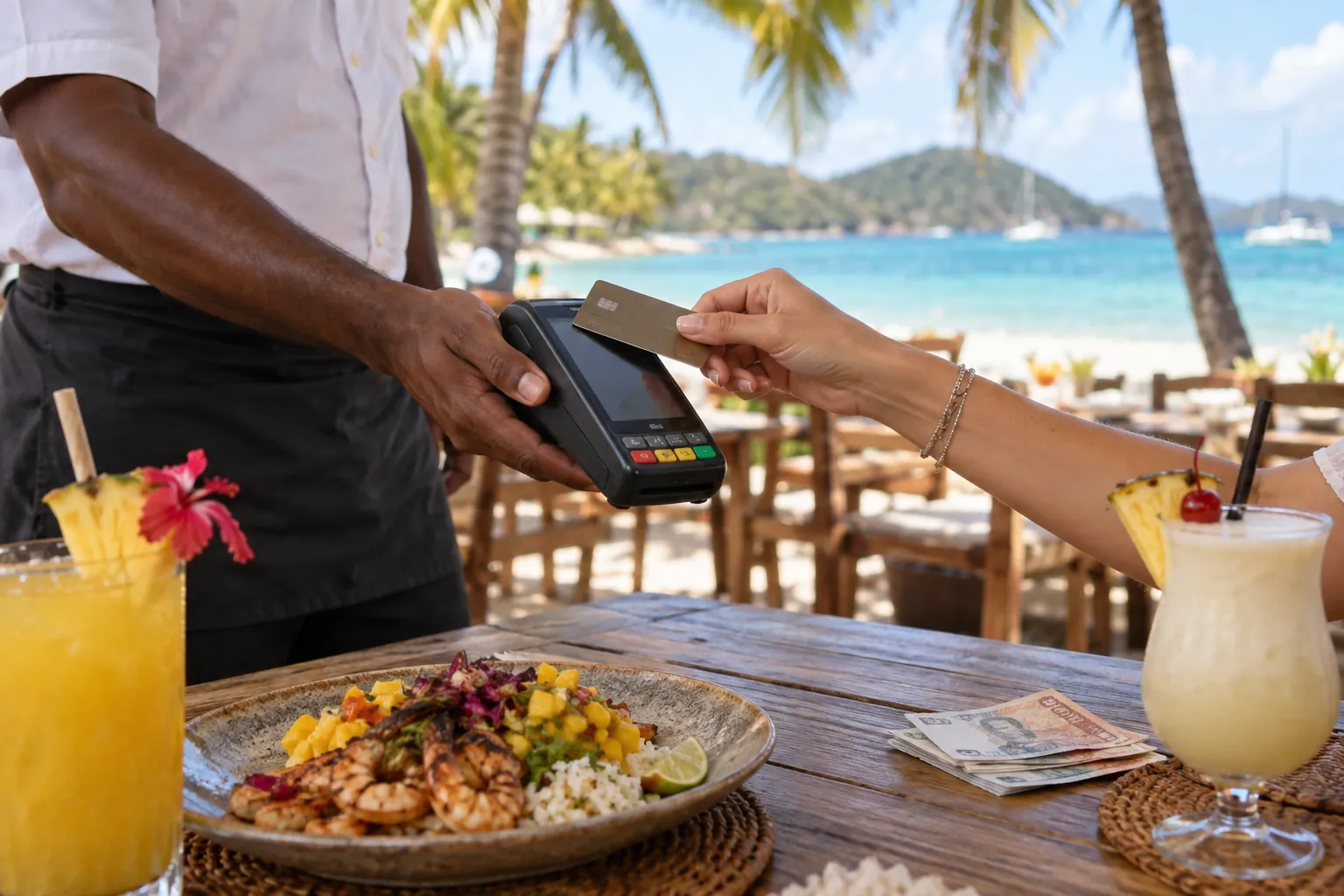
Quick answer. If I were visiting Punta Cana, I would bring a modest amount of US cash in small bills for tips and backup, use Dominican pesos for everyday local prices outside the resort, and pay larger trusted merchants by card in pesos whenever possible. At ATMs and card terminals I would normally decline any offer to convert the transaction into dollars and let my own bank do the conversion. I would use only major-bank ATMs in secure places, keep my card in sight at all times, and treat hotel and rental-car deposits as money that may be unavailable for a few days.
Punta Cana is heavily dollarized, but the Dominican peso (DOP, written RD$) is the country’s official currency. Hotels, excursions, airport transfers and plenty of tourism businesses quote prices in US dollars, so you can spend a whole resort vacation without touching many pesos. That convenience also hides one of the easiest ways to overspend: a poor exchange rate, paying in the wrong currency, an expensive ATM conversion, and the same mistake repeated for a week.
The goal is not to obsess over every peso. It is to know the rough exchange rate, pick the right currency at the right moment and skip conversion fees you do not need. On September 15, 2026, the Central Bank of the Dominican Republic published reference rates of RD$58.7567 to buy a US dollar and RD$59.0804 to sell one. For mental math, I simply treat US$1 as roughly RD$60.
The simple system I would use
| Situation | Best default | Why | Watch for |
|---|---|---|---|
| Tips at an all-inclusive | Small USD bills or pesos | Both are easy for staff to use; $1 and $5 bills are convenient | Do not arrive with only $20, $50 and $100 bills |
| Local restaurant, supermarket, pharmacy | Pesos, or a card charged in DOP | Local prices are normally in pesos | Do not let the terminal convert the total to your home currency without checking the rate |
| Taxi, transfer, excursion quoted in USD | Pay the agreed USD amount | Avoids a second, informal conversion | Confirm the total before the service starts |
| ATM withdrawal | Pesos from a major-bank ATM | You get local currency and can compare costs clearly | Decline the ATM’s home-currency conversion; check ATM and bank fees |
| Hotel or rental-car deposit | Credit card if practical | A hold reduces available credit instead of freezing cash in your checking account | Ask the exact hold amount and how it is released |
| Street vendor, small purchase | Small peso cash | Faster and avoids vague dollar conversions | Agree the price first and carry only a little cash |
Do you actually need Dominican pesos?
Not necessarily on your first day, and not in large amounts if you are staying inside an all-inclusive. US dollars are widely accepted in Punta Cana’s tourist economy. The country’s official tourism website says tourist-area restaurants, bars, department stores, souvenir shops and supermarkets often accept dollars, and also warns that the rate businesses offer is usually worse than a bank’s.
That is the key distinction: accepted does not mean optimal. I pay in dollars when something is honestly priced in dollars, such as a transfer or an excursion with an agreed USD price. I prefer pesos when the real price is in pesos and someone is merely offering to convert it for me on the spot.
A 10-second exchange-rate check that can save real money
At roughly RD$59 to the dollar, a RD$3,000 bill is about US$51. If someone tells you the same bill is US$60, the dollar option costs you roughly 18% more. You do not need a calculator for every purchase. Just remember that RD$600 is about US$10, RD$3,000 about US$50 and RD$6,000 about US$100 at a rate near 60.
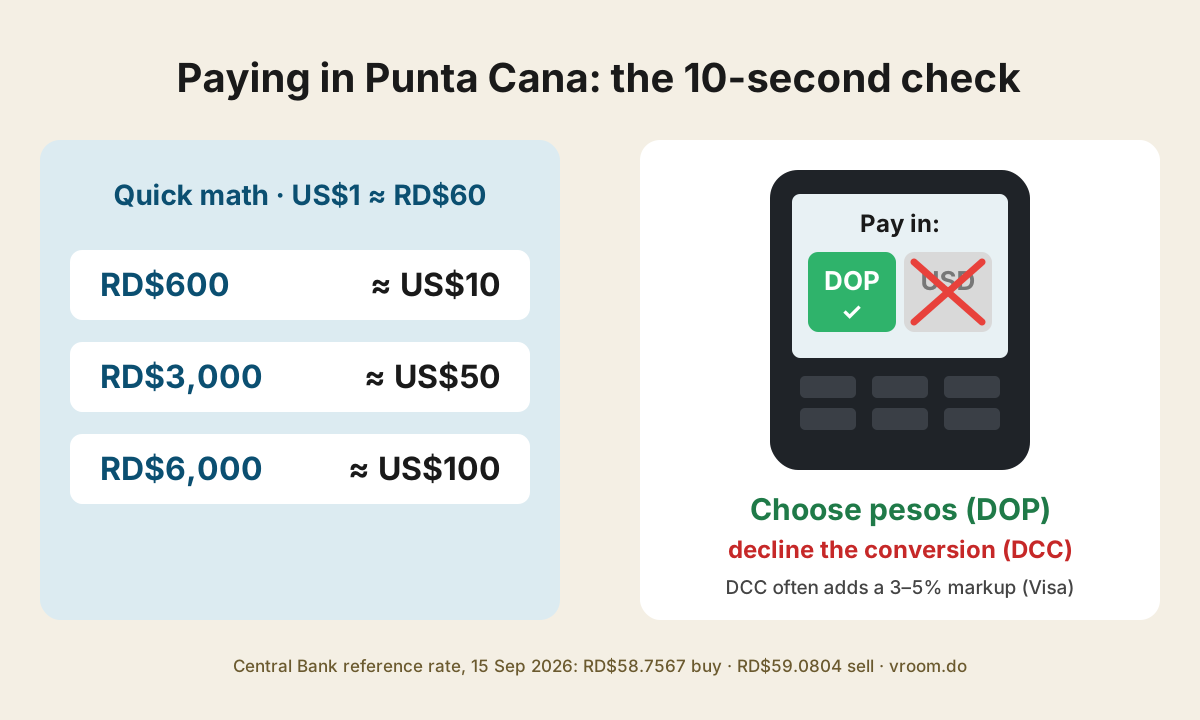
My rule: if the price is displayed in pesos, I want the peso price first. If the business offers a dollar total, I check it against the rough 60-to-1 rate before agreeing.
The biggest card mistake: accepting Dynamic Currency Conversion
When you pay by card or withdraw cash, the terminal may ask whether to process the transaction in Dominican pesos or in your home currency, whether that is US dollars, Canadian dollars, euros or pounds. That service is called Dynamic Currency Conversion, or DCC. Visa explains that DCC includes an exchange rate and may include extra fees or a markup, and its travel guidance says paying in your home currency this way often costs a 3–5% markup built into the rate. Visa also requires merchants and ATMs that offer DCC to show both currencies, the rate and any markup, and to let you accept or decline.
My default: if a Dominican terminal asks “USD or DOP?” and the purchase itself is in pesos, I choose DOP. That way my card issuer or network does the conversion instead of the merchant or the ATM operator. Check your own card’s foreign-transaction fee, though: a card that charges 3% abroad changes the math.
Which ATMs should you use in Punta Cana?
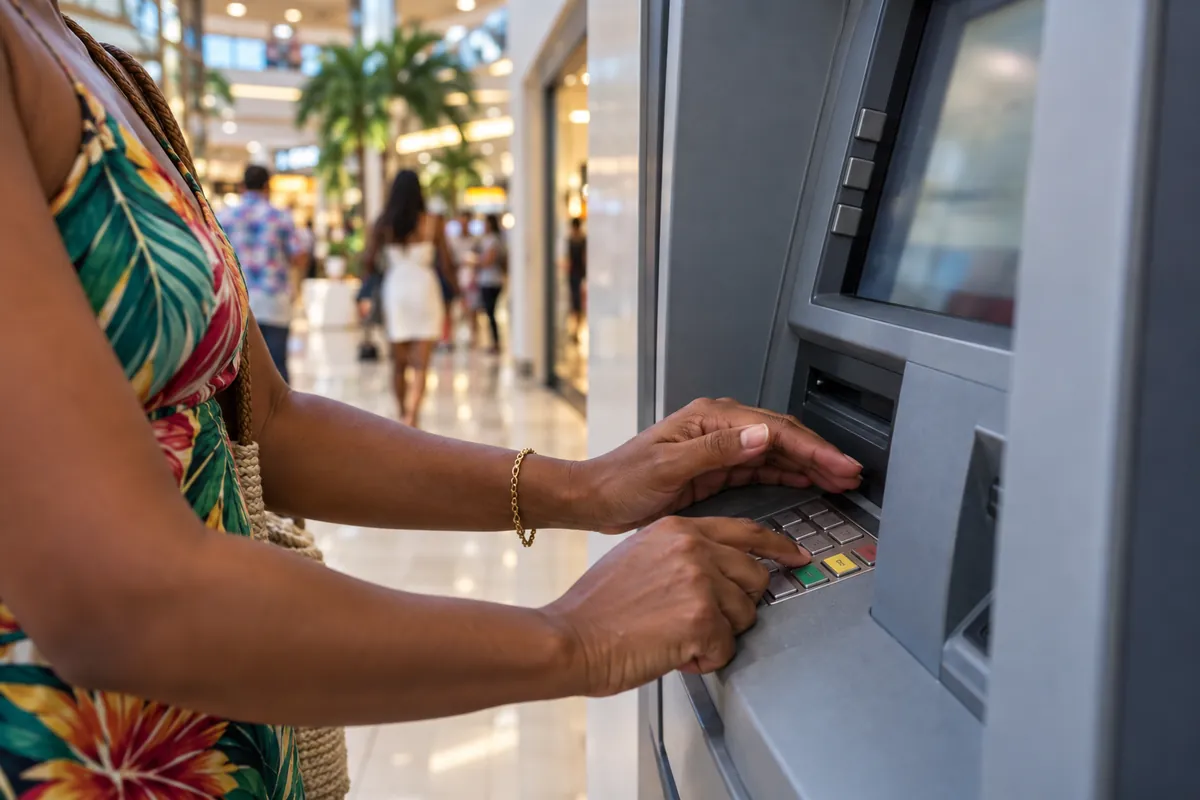
I stick to ATMs run by large Dominican banks such as Banreservas, Banco Popular or BHD, ideally inside a bank branch, a shopping mall, a supermarket or another busy, well-lit place. I avoid unfamiliar freestanding machines in quiet spots.
This is not paranoia. Banreservas publishes specific warnings about ATM skimming: criminals may fit a fake card reader, camera or keypad to capture card data and PINs. Its advice is to inspect the machine, cover the keypad while typing your PIN, use ATMs in secure places and switch on transaction alerts. The official tourism site likewise recommends indoor ATMs at established banks.
How I would withdraw cash
- Use a major-bank ATM in a secure, busy location.
- Check the card slot and keypad. If anything looks loose, added or odd, walk away.
- Cover the keypad when entering your PIN.
- Withdraw Dominican pesos, not an amount the ATM has converted into your home currency.
- If the ATM offers its own exchange rate, compare it carefully; I normally decline DCC.
- Check both the ATM fee and any fee your own bank charges.
- Turn on instant transaction notifications before the trip.
- If a withdrawal or charge looks wrong, lock the card and call your issuer immediately.
Never let your card disappear from view
In the Dominican Republic you may hear staff call a card terminal a “verifón”, a local nickname taken from the Verifone brand. If the terminal in a restaurant is portable, ask them to bring it to the table. If it is fixed somewhere else, I would rather walk over with the employee than hand over my card and watch it vanish into another room.
I learned this the expensive way. Once my card was taken out of my sight, and later I found about US$600 in unauthorized charges that I never got back. I cannot prove exactly what happened to the card in those minutes, but it changed the way I pay for good: the card stays where I can see it. Local banks back this habit. In a 2026 fraud-prevention article, Banreservas lists restaurants where the card leaves your sight as a higher-risk situation and advises keeping the card visible, asking for the payment to be processed in front of you, paying contactless when possible and activating alerts.
Credit card or debit card?
For larger travel purchases, a credit card is usually the more comfortable way to manage risk: a fraudulent charge does not immediately drain your checking account, and many issuers offer dispute protection. Debit cards work too, but hotel, fuel and rental-car holds can temporarily cut the cash available in the account behind them. Before you travel, check your issuer’s foreign-transaction fee, ATM fee, travel-notice rules and fraud policy.
Paying at gas stations: watch the pump, not just the receipt
Fuel stations are another place to stay alert. The Dominican quality authority INDOCAL runs a legal-metrology program that verifies fuel dispensers, but a correctly calibrated pump cannot stop a dishonest person from muddling the total.
My routine is simple. Before fueling starts, I check that the display has reset to zero. When it ends, I read the final amount on the pump before paying, and that is the number I pay. I have personally had attendants reset the display and then ask for a different, much higher amount; once, the figure was more than a full tank of my car could physically cost. That does not happen at every station, and most people you meet are honest and helpful, but a ten-second check prevents an easy dispute.
My gas-station checklist
- Confirm the pump shows zero before fueling begins.
- Know whether you asked for a fixed amount or a full tank.
- Read the final amount before the display is cleared.
- If paying by card, keep it in sight and check the amount on the terminal before approving.
- Keep the receipt until the charge shows up correctly in your banking app.
The rest of the local driving routine, from tolls to police checkpoints, is in our guide to driving in the Dominican Republic.
Hotel and rental-car deposits: a hold is not always a charge
Hotels and rental-car companies often need a deposit or a card authorization because the cost of possible incidentals or damage is unknown at check-in or pickup. It can show up in your banking app as a pending amount and reduce your available balance or credit limit even though it is not a completed purchase.
Visa explains that hotels, gas stations and car-rental companies may place temporary holds. On debit cards those holds reserve real money in the account until the final transaction goes through and the hold is released, so it can be unavailable for other spending for several days.
Before accepting a deposit, ask four questions
- What exact amount will be held or charged?
- Is it a preauthorization hold or an actual refundable charge?
- In which currency will it be processed?
- How and when will it be released after checkout or vehicle return?
Keep the checkout or return receipt until the hold disappears, and if your credit line or debit balance is tight, leave room for the deposit before you fly. For comparison, at VROOM.DO the refundable deposit is $200 for compact cars and $300 for SUVs and larger cars, it can be paid in cash or by card, it is returned in US dollars in cash, and you do not need a credit card to book. Why the deposit and the insurance deductible matter so much in this country is covered in our guide to rental car insurance in the Dominican Republic.
Restaurants, taxes and tips: read the bill before adding more
The country’s official travel tips say restaurant bills normally include 18% ITBIS (sales tax) plus a 10% service charge. That 10% is not the same as an extra, voluntary tip. The tourism authority says an additional tip is customary if you want to reward good service, but the amount is your call.
At resorts, small US bills are extremely practical, so bring plenty of $1 and $5 notes rather than relying on big ones. Recent traveler discussions from 2026 show the same pattern: many all-inclusive guests use small dollar bills for drinks, housekeeping and bell staff, while people who spend more time outside the resort prefer pesos for everyday purchases.
Practical tip: get small bills before you fly. Breaking a $50 or $100 note is often far more annoying than carrying a stack of ones and fives. A $1–2 tip for small services is common and easy to understand, but tipping is voluntary and should reflect the service you got.
Where should you exchange money?
For cash pesos, I prefer a major-bank ATM or an exchange at a bank or an authorized exchange office. The official tourism site says the airport is fine for convenience but not necessarily the place to change larger amounts; banks use the Central Bank rate as their benchmark, and authorized exchange offices are easy to find. I would not change a big sum on day one. Rates move, plans change, and leftover pesos are one more conversion at the end of the trip. Take out or change what you will realistically use.
What I would carry for different types of trips
| Trip type | What I would carry | Why |
|---|---|---|
| 7 days at an all-inclusive | Small USD bills, 1–2 cards, a little DOP if needed | Most big costs are prepaid; cash is mainly for tips, souvenirs and the odd extra |
| Airbnb, eating out, exploring | Some USD as backup, regular DOP withdrawals, a card | Local restaurants, supermarkets and services are easier to compare in pesos |
| Road trip or rental car | DOP cash, a card with available credit, a little USD backup | Fuel, tolls, parking and local purchases make pesos useful; the card may need room for a rental deposit |
If you are still deciding whether a car is worth it for your trip, you can see our current cars and rental conditions.
Should you expect to be scammed in Punta Cana?
No. I would not describe Punta Cana as a place where every tourist is constantly being ripped off. Most people are friendly, and most transactions are completely normal. But a holiday creates exactly the conditions opportunists like: visitors are relaxed, unfamiliar with the currency, in a hurry and often paying without checking the details.
The right approach is awareness, not fear. Know the rough exchange rate. Agree on prices before a service starts. Keep your card visible. Check the amount on the terminal. Watch the fuel pump. Use established ATMs. Turn on banking alerts. Those habits take seconds and let you relax for the rest of the trip.
Money checklist before you fly
- Check whether your card charges a foreign-transaction fee.
- Check your daily ATM limit and overseas ATM fees.
- Turn on instant purchase and withdrawal notifications.
- Bring at least two payment methods and keep them separately.
- Bring small $1 and $5 bills for tips and backup.
- Save your card issuer’s international phone number.
- Know the approximate exchange rate before you land.
- Do not carry all your cash and cards with you every day.
Punta Cana money FAQ
Should I bring US dollars or Dominican pesos to Punta Cana?
Bring some US dollars, especially small bills, but do not assume dollars are cheapest for every purchase. If you spend time outside an all-inclusive resort, pesos are useful for local-priced purchases and make price comparisons much easier.
Can I use US dollars everywhere in Punta Cana?
They are widely accepted in tourist areas, but not literally everywhere, and the exchange rate a merchant offers may be worse than the bank rate. The official currency is the Dominican peso.
Should I choose USD or DOP on a card terminal?
If the original purchase is in Dominican pesos, I normally choose DOP and decline Dynamic Currency Conversion, so my card issuer or network handles the conversion. Check your own card’s foreign-transaction fee first.
Should I accept the ATM exchange rate?
Not automatically. If the ATM offers to convert your peso withdrawal into your home currency, that is usually DCC. Compare the displayed rate and markup; I normally decline the conversion and withdraw local currency.
Are ATMs safe in Punta Cana?
Major-bank ATMs in busy, secure locations are the option I prefer. Banreservas and the official Dominican tourism site both recommend secure or indoor locations and standard anti-skimming precautions.
Is it better to use a credit card or cash in Punta Cana?
Use both. Cash is convenient for tips and small local purchases; cards are useful for larger purchases and reduce how much cash you carry. A card with no foreign-transaction fee is especially useful.
Why did my hotel or rental company block money on my card?
It is probably an authorization hold for incidentals or a security deposit. The amount temporarily reduces your available credit or debit balance until the merchant and your issuer release it.
How much should I tip in Punta Cana?
There is no single mandatory amount for resort tips. Small US-dollar bills are convenient, and $1–2 for small services is common. Restaurant bills normally already include 10% service plus 18% ITBIS, so read the bill before adding more.
Should I exchange money at Punta Cana airport?
Only if convenience matters more than the rate. The official tourism authority recommends banks or established exchange offices for better value and treats the airport as a convenience option for your first cash.
What is the easiest way to remember the peso–dollar rate?
In mid-September 2026 the official reference rate was about RD$59 per US$1. For quick vacation math, treating US$1 as roughly RD$60 is close enough: RD$600 is about US$10, RD$3,000 about US$50.
The one rule to remember
Pay attention to the currency before you pay. Most money mistakes in Punta Cana are not dramatic scams. They are small conversion losses, needless fees, wrong assumptions and the moments when a traveler stops checking the numbers. Use dollars when the real price is in dollars and pesos when it is in pesos, decline conversions you do not need, and keep control of your card. That system is simple enough to follow for a whole vacation.
Sources
- Central Bank of the Dominican Republic: foreign-exchange market and reference rates
- Dominican Republic Ministry of Tourism (Go Dominican Republic): travel tips; FAQs
- Visa: Dynamic Currency Conversion explained; debit-card holds at hotels, gas stations and car rentals
- Banreservas: ATM card-cloning fraud; card cloning at merchants and how to prevent it
- INDOCAL: legal metrology and fuel-dispenser verification
- Reddit r/PuntaCana: which currency to use in Punta Cana (2026)
Exchange rates, bank fees, card-issuer policies and merchant practices change. Always check the amount, currency and terms shown at the moment you pay. The personal stories in this guide describe my own experience and are not claims about every business in Punta Cana.
Ready to hit the road?
Rent a car in Punta Cana with no hidden fees — full insurance and unlimited mileage included.
Search cars for your trip